
Atlantic Meridional Overturning Circulation (AMOC)
- 15 Apr 2026
In News:
The Atlantic Meridional Overturning Circulation (AMOC) is currently at the center of global climate discourse. Recent studies published in Nature Communications and Science Advances (2026) warn that this vital oceanic system is showing signs of a steady decline, potentially nearing a "tipping point" that could trigger irreversible shifts in the Earth's climate and carbon cycles.
Understanding the AMOC: The "Oceanic Conveyor Belt"
The AMOC is a large-scale system of ocean currents that acts as a vertical loop spanning the entire length of the Atlantic Ocean. It is a critical component of the Earth's thermohaline circulation (driven by temperature and salinity).
- The Mechanism: It transports warm, salty water from the tropics northward along the surface. In the North Atlantic, this water cools, becomes denser, and sinks to the deep ocean. This cold, dense water then flows southward along the ocean floor, eventually resurfacing in other regions to complete the cycle.
- The Gulf Stream: A major component of the AMOC, the Gulf Stream is responsible for maintaining the relatively mild climates of Western Europe and the Eastern coast of North America.
Reasons for the Current Weakening
Scientists have observed a consistent decline in AMOC strength over the past two decades, particularly along the western boundary.
- Greenhouse Gas Forcing: Rising global temperatures are the primary driver of this instability.
- Freshwater Influx: The rapid melting of the Greenland Ice Sheet pours massive amounts of freshwater into the North Atlantic. This reduces the salinity and density of the water, preventing it from sinking and thereby "stalling" the conveyor belt.
- Tipping Point Projections: Research suggests a complete collapse could occur as early as 2037, or at least by 2109, if current warming trends continue.
Consequences of an AMOC Collapse
A shutdown of the AMOC would lead to a dramatic redistribution of heat and carbon across the planet, with impacts categorized into three main areas:
A. Global Warming & Carbon Feedback
- Source vs. Sink: Traditionally, the Southern Ocean acts as a "carbon sink," absorbing $CO_2$. A collapse would turn it into a carbon source, releasing deep-ocean $CO_2$ back into the atmosphere.
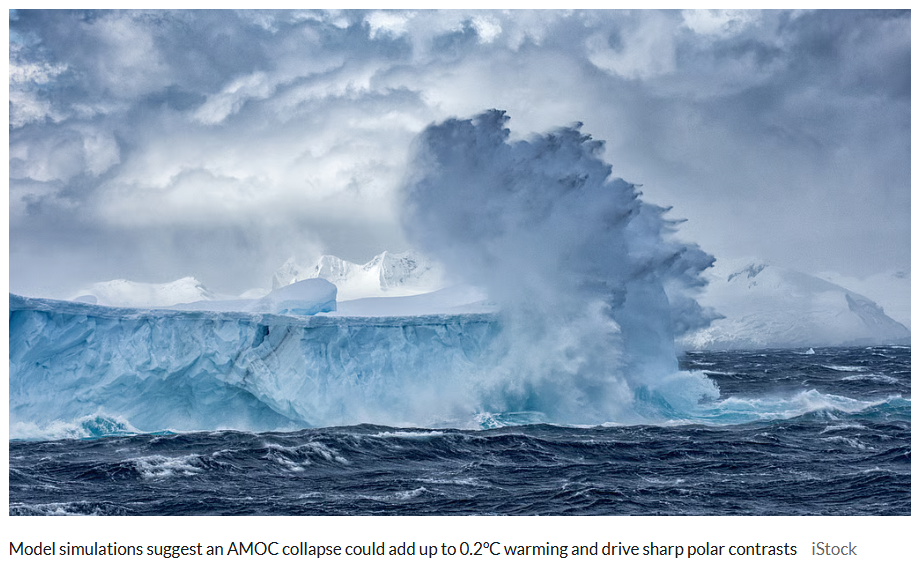
- Extra Warming: This release of 47–83 gigatonnes of $CO_2$ could add an additional 0.2°C to global average temperatures, exacerbating the greenhouse effect.
B. Regional Temperature Shifts
The collapse would create a "bipolar seesaw" effect in global temperatures:
- Northern Hemisphere Cooling: Without warm water transport, the Arctic and North Atlantic could see temperatures plummet by up to 7°C. This would be amplified by the sea-ice-albedo feedback, where increased ice cover reflects more sunlight, causing further cooling.
- Southern Hemisphere Warming: Conversely, parts of Antarctica could see a temperature rise of 6°C to 10°C as heat that was once transported north remains trapped in the south.
C. Ecological and Meteorological Disruptions
- Rainfall Patterns: Europe would likely face a significant decrease in rainfall, impacting agriculture and water security.
- ENSO Interaction: Changes in Atlantic circulation are expected to influence the El Niño-Southern Oscillation (ENSO), potentially leading to more frequent or extreme weather events globally.