
New Species of Dragonflies
- 25 Apr 2026
In News:
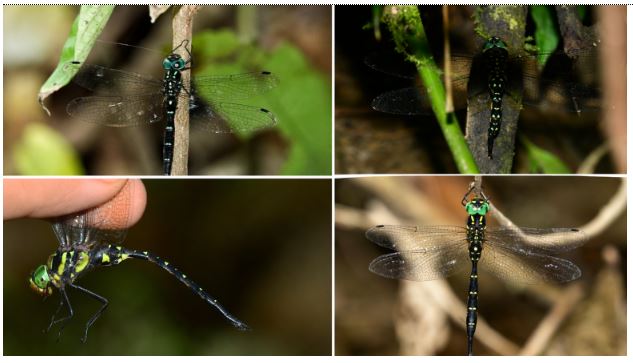
The recent discovery of three new dragonfly species in Northeast India marks a significant milestone for Indian entomology and underscores the region's status as a global biodiversity hotspot. Published in the journal Zootaxa, the study by researchers from the National Centre for Biological Sciences (NCBS) and local naturalists highlights the "micro-endemic" nature of species in the Siang Valley and Assam’s forest fringes.
The New Additions to India’s Odonate Fauna
The discoveries belong to the rare genus Sarasaeschna (commonly called Boghawkers), which are known for their preference for shaded, high-altitude forest ponds and wetlands.
- Clouded Boghawker (Sarasaeschna nuboides)
- Location: Discovered in the Siang Valley of Arunachal Pradesh, near the periphery of Mouling National Park.
- Characteristics: It is named for the distinctive "cloudy" or nebulous wing markings. It was observed flying rapidly over shallow, shaded forest ponds.
- Siang Boghawker (Sarasaeschna sigotaayo)
- Location: Also found in the Siang Valley, Arunachal Pradesh.
- Etymology: The name "Sigotaayo" is derived from the local Adi language, where ‘Siang’ refers to the big river. It possesses bolder thoracic stripes compared to its relatives.
- Long-tailed Boghawker (Sarasaeschna dosdewaensis)
- Location: Discovered in the Karimganj district of Assam (specifically the Dosdewa forest village).
- Background: This area is increasingly recognized as an "Odonate Diversity Hotspot." The species is characterized by its exceptionally elongated male caudal appendages (tail structures).
Ecological and Biological Significance
Dragonflies belong to the order Odonata and are among the oldest living insect lineages, predating dinosaurs by over 100 million years. Their role as bio-indicators is crucial:
- Environmental Health: Dragonflies are sensitive to changes in water quality and habitat structure. Their presence indicates healthy, oxygen-rich freshwater ecosystems.
- Apex Predators of the Insect World: Equipped with nearly 360-degree vision, they are voracious predators of mosquitoes and flies, acting as natural biological control agents.
- Taxonomic Milestone: Along with the three new species, the researchers also rediscovered the Khasi Boghawker (Sarasaeschna khasiana) in Meghalaya after a gap of 58 years, confirming its persistence in the Khasi Hills.
Dragonflies vs. Damselflies: Key Distinctions
While both belong to the order Odonata and share similar life cycles, they can be differentiated by their morphology and behavior:
- Resting Posture: This is the most visible difference. Dragonflies hold their wings horizontally (spread out) when at rest. In contrast, damselflies typically fold their wings together, holding them straight up above their bodies.
- Physical Build: Dragonflies are generally larger and more robust with powerful flight capabilities. Damselflies are smaller, more slender, and appear "delicate" in flight.
- Eye Position: Dragonfly eyes are very large and often touch at the top of the head. Damselfly eyes are separated, resembling dumbbells on either side of the head.