
Truck Mounted Attenuators (TMAs)
- 23 Apr 2026
In News:
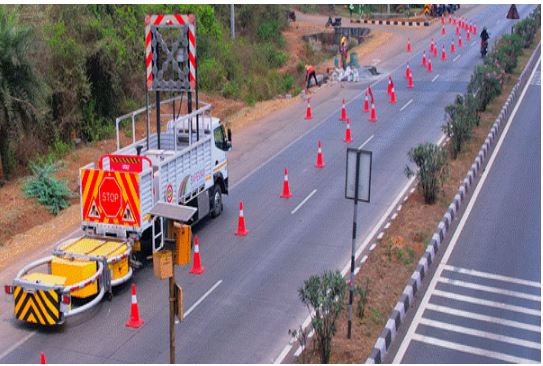
As India aggressively expands its National Highway network, the Ministry of Road Transport and Highways (MoRTH) has shifted its focus from mere connectivity to achieving global standards in road safety. A critical component of this transition is the deployment of Truck Mounted Attenuators (TMAs), a technology-driven intervention designed to safeguard both highway commuters and the personnel maintaining India's high-speed corridors.
Understanding Truck Mounted Attenuators (TMAs)
A Truck Mounted Attenuator is an advanced, energy-absorbing safety device attached to the rear of a service vehicle. It acts as a sacrificial barrier, designed to crumple and absorb the kinetic energy of an errant vehicle before it can strike maintenance crews or construction machinery further ahead.
Key Technical Standards
To ensure reliability, the units deployed on Indian highways comply with rigorous international crash-test protocols:
- MASH Test Level-3 (TL-3): This modern standard ensures the device can handle impacts from heavier vehicles at higher speeds.
- NCHRP 350 Test Level-3: A globally recognized benchmark for roadside safety hardware.
- Impact Resilience: These systems are engineered to withstand and dissipate the force of a collision at speeds of up to 100 km/h.
Core Functions and Impact Mitigation
The deployment of TMAs serves a dual purpose: active prevention and passive protection.
1. Kinetic Energy Dissipation: In the event of a rear-end collision, the attenuator structure collapses in a controlled manner. This dissipation of force significantly:
- Reduces the severity of injuries for the occupants of the crashing vehicle.
- Prevents the service truck from being pushed forward into the maintenance zone where workers are operating.
2. Early Warning Systems: Prevention is achieved through integrated Wig-Wag Warning Lights. These high-intensity lights flash in alternating patterns to form clear directional arrows. This is particularly vital in:
- High-speed corridors where reaction times are minimal.
- Low-visibility conditions, such as heavy fog or nighttime operations.
- Advanced Alerting: By providing a visual cue well in advance, these signals nudge drivers to change lanes safely, preventing the accident entirely.
Strategic Significance for India
The integration of TMAs into the Indian road ecosystem carries profound implications:
- Reduction in Work-Zone Fatalities: Construction zones are high-risk environments. TMAs provide an "invisible shield" for ground workers who are often vulnerable to speeding traffic.
- Economic Resilience: By minimizing accident severity, the government reduces the massive economic loss associated with road fatalities and long-term disability.
- Global Best Practices: The move aligns India with the infrastructure standards of developed nations, making Indian highways safer for international logistics and transit.