
Limnonectes motijheel
- 24 Apr 2026
In News:
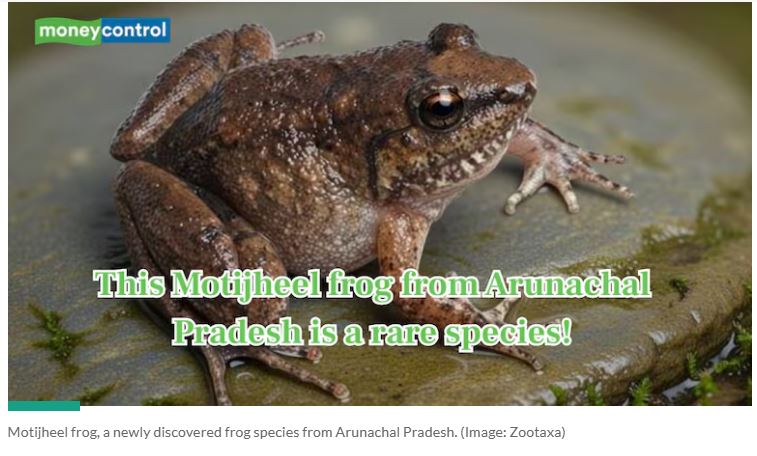
In a significant breakthrough for Indian herpetology, scientists have discovered a rare species of fanged frog, Limnonectes motijheel, within the pristine ecosystems of the Namdapha Tiger Reserve in Arunachal Pradesh. This discovery underscores the immense, yet often hidden, biodiversity of the Eastern Himalayas and provides new insights into the evolution of amphibian breeding behaviors.
The Anatomy and Behavior of Limnonectes motijheel
The newly identified species belongs to the genus Limnonectes, a group of amphibians spread across South and Southeast Asia. With this addition, the number of known Limnonectes species in India has risen to six.
Key Biological Features:
- The "Fangs": The frog is characterized by small, bony, fang-like projections in the lower jaw of the males. These are not true teeth but are believed to be used for territorial combat or as an aid in feeding.
- Physical Appearance: It possesses a distinct dark-brown line between the eyes, an inverted "V"-shaped ridge on its back, and broken longitudinal folds along its flanks.
- Dimensions: As a medium-sized amphibian, adults typically measure between 2.3 to 3.5 centimeters.
- Naming: The species is named after Motijheel, a site within Namdapha renowned for its exceptionally high amphibian density and diversity.
Unique Breeding: The Mud-Nester
Perhaps the most striking feature of Limnonectes motijheel is its reproductive strategy. Unlike most frogs that deposit eggs in water bodies or on overhanging foliage, this species constructs a mud nest beneath leaf litter on the forest floor. This specific "house-building" behavior is a unique adaptation for moisture retention and predator avoidance, and it represents the first recorded instance of mud-nesting within this genus in India.
Namdapha Tiger Reserve
The discovery highlights the ecological importance of Namdapha, a National Park and Tiger Reserve located in the Changlang District of Arunachal Pradesh, bordering Myanmar.
Geographic and Ecological Significance:
- Biogeographical Junction: Namdapha sits at the confluence of the Indian Sub-Continent and Indo-China Biogeographic Regions. It is nestled between the Mishmi Hills (Dapha Bum ridge) and the Patkai ranges.
- Hydrology: The reserve is drained by the Namdapha River, a tributary of the Noa-Dihing, which flows through the heart of the park.
- Vegetation Gradient: Due to its vast altitudinal range, the park exhibits a diverse floral spectrum, ranging from Tropical Evergreen and Moist Deciduous forests to Temperate and Alpine Scrub forests.
Biodiversity Highlights:
- The Four Big Cats: Namdapha is the only park in the world that serves as a habitat for four species of big cats: Tiger, Leopard, Snow Leopard, and Clouded Leopard.
- Rare Fauna: It is home to the Hoolock Gibbon (India’s only ape), the Slow Loris, and the Himalayan Sun Bear.
- Endangered Flora: The park hosts the rare Blue Vanda orchid and the medicinal plant Mishimi Teeta (Copti teeta), which is central to the traditional medicine of local tribes.