
‘Yellow Line’ Security Strategy
- 24 Apr 2026
In News:
In a significant shift of military doctrine, the Israeli government has officially expanded its Yellow Line strategy from the Gaza Strip to Southern Lebanon. By April 2026, following a ceasefire with Hezbollah, the Israel Defense Forces (IDF) began replicating the "Gaza Model" in the north, establishing a militarized buffer zone that extends up to the strategic Litani River.
Defining the 'Yellow Line'
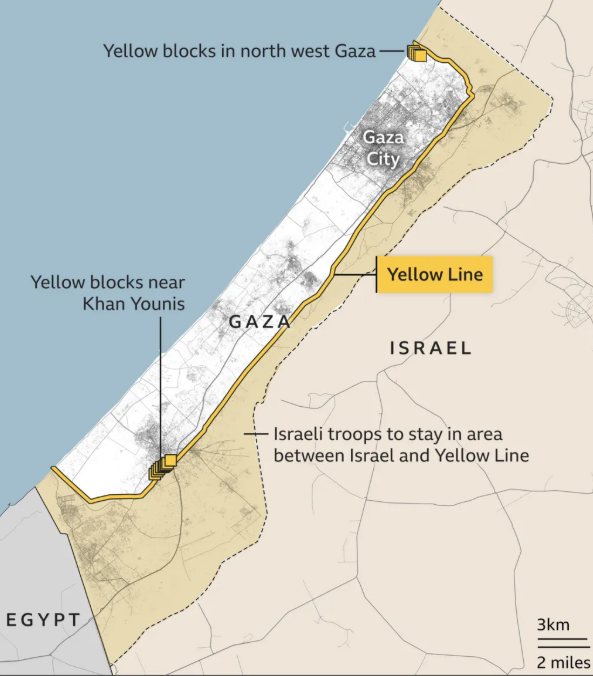
The Yellow Line is not a political border but a military demarcation and a strategic construct. It is a fortified, static boundary placed deep within hostile territory to create a free-fire zone under direct and open-ended Israeli military control.
- Physical Manifestation: The line is literally color-coded. It is marked by yellow-painted concrete bollards spaced at 200-meter intervals and 3.5-meter-high poles.
- Operational Context: Unlike the Green Line of 1967, which was a traditional ceasefire line, the Yellow Line is an internal partition that divides an enclave into Israeli-occupied zones and local administrative areas.
Chronology and Historical Roots
The philosophy behind the Yellow Line draws from historical Israeli deployment boundaries like the Green Line and the Area A demarcations in the West Bank. However, its modern application is far more intrusive:
- Gaza Strip (October 2025): First introduced as part of a peace framework proposed by US President Donald Trump. It placed approximately 58% of the Gaza Strip under Israeli military control, confining the local population to just 42% of the territory.
- Southern Lebanon (April 2026): Following the northern conflict, the strategy was applied to Lebanon, creating a forward defensive posture designed to prevent militant groups from launching close-range attacks on Israeli border communities.
Strategic Objectives and Military Features
The primary goal of the Yellow Line is forward defense—transitioning from mobile combat to a permanent, static presence.
- Static Defense Infrastructure: The line is reinforced with fortified outposts, earth mounds, radio towers, and surveillance sensors.
- Total Control Zones: The area east of the line is classified as a closed military zone. The IDF maintains the authority to level infrastructure and prevent civilian return within this perimeter to ensure a "clear view" for security forces.
- Resource Intensity: This strategy is high-maintenance. Sustaining the line in Gaza alone requires two full IDF divisions, creating a continuous strain on Israel’s reserve forces and national budget.
International and Humanitarian Significance
The "Yellow Line" has sparked intense global debate, with international bodies like the OHCHR (Office of the High Commissioner for Human Rights) and Euro-Med raising significant alarms.
1. Creeping Annexation: Critics argue the doctrine represents a shift toward "creeping annexation," where permanent military buffers become the standard response to regional conflicts, effectively shrinking the sovereign territory of neighboring entities.
2. Forced Displacement and Ghettoization: The strategy has been classified by human rights organizations as a tool for "ghettoization." By cutting off access to vital agricultural lands, urban centers, and water resources (like the Litani River), it induces long-term displacement of the local population.
3. Regional Stability: While Israel views the line as a necessary shield for its border communities, regional analysts suggest it may become a flashpoint for future friction, as the permanent occupation of foreign soil often fuels long-term insurgency.