
Vishwa Sutra Initiative
- 22 Apr 2026
In News:
In a significant stride toward elevating India’s traditional craftsmanship, the Ministry of Textiles recently launched the ‘Vishwa Sutra – Weaves of India for the World’ initiative. Orchestrated by the Office of the Development Commissioner (Handlooms) in partnership with the National Institute of Fashion Technology (NIFT), this program seeks to bridge the gap between ancient heritage and modern international aesthetics.
The Core Vision: Globalizing Tradition
The "Vishwa Sutra" initiative is designed to place Indian handlooms within a contemporary global design framework. Rather than viewing handlooms as static relics of the past, the project treats them as dynamic canvases capable of resonating with international consumers.
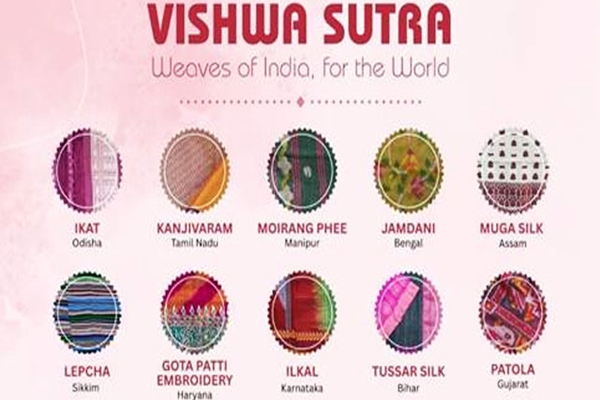
- Diverse Representation: The initiative brings together 30 distinct handloom weaves, each curated to represent a specific Indian state.
- Cultural Fusion: Each of these 30 weaves has been creatively reinterpreted using design inspirations from 30 different countries. This cross-cultural dialogue blends traditional Indian techniques with global fashion sensibilities.
Notable Cross-Cultural Reinterpretations:
- Odisha Ikat: Reimagined through the lens of Greek geometric forms.
- Kanchipuram (Tamil Nadu): Infused with Norwegian minimalist lines.
- Muga Silk (Assam): Integrated with structural Egyptian elements.
- Patola (Gujarat): Reinterpreted with vibrant Spanish influences.
- Banarasi (Uttar Pradesh): Designed into UAE-inspired ensembles.
Strategic and Economic Significance
1. The 5F Framework: Vishwa Sutra acts as a practical implementation of the government’s 5F Vision:
- Farm (Cotton/Silk cultivation) Fibre(Spinning) Factory(Weaving) Fashion(Design) Foreign (Export).
This linear progression ensures that the benefits of global demand reach the primary producers—the weavers—strengthening the rural economy.
2. From "Vocal for Local" to "Local to Global": The initiative marks a transition in the government's industrial policy. By making traditional industries globally competitive, it aims to increase India's share in the global textile market, which is currently dominated by mass-produced fast fashion.
3. Preservation of Intangible Heritage: By providing a modern market for traditional techniques, the initiative ensures the survival of skills that have been refined over generations. It provides a financial incentive for the younger generation of weaver communities to continue their ancestral crafts.