
Rising Labour Protests in India
- 21 Apr 2026
In News:
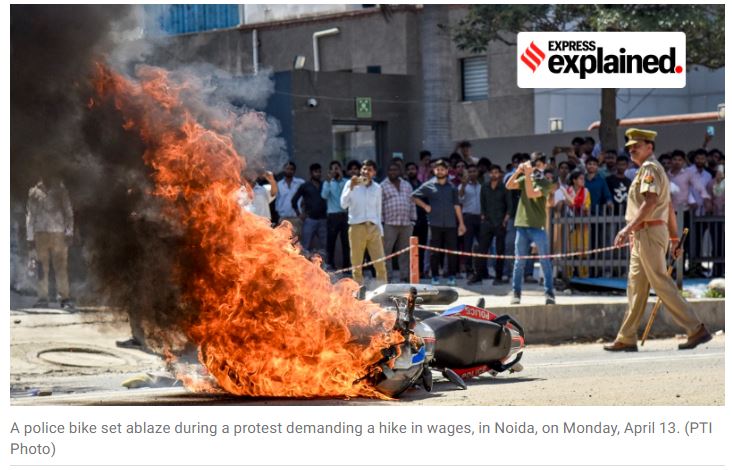
Industrial hubs in North India, specifically Noida (Uttar Pradesh) and Manesar (Haryana), have recently emerged as epicenters of violent labour protests. These demonstrations represent a critical inflection point in India’s industrial relations, highlighting a deepening rift between the workforce, employers, and state regulatory frameworks.
The Landscape of Discontent: Current Realities
The contemporary wave of labour unrest is characterized by a "decoupling" of wages from the actual cost of living. While the Indian industrial sector has seen recovery in production, the benefits have not trickled down to the grassroots level. Workers are currently agitating against stagnant base pays and the ambiguity surrounding the transition to the 2025 Labour Codes.
Statistical Overview of Labour Vulnerability
- The Inflation-Wage Gap: Between 2021 and 2026, the Consumer Price Index for Industrial Workers (CPI-IW) surged by 24.8%. In contrast, wage increments in industrial states like Haryana averaged only 15%, leading to a significant contraction in real income and purchasing power.
- The Minimum Wage Chasm: Before the most recent emergency revisions, an unskilled worker in Haryana earned approximately ?11,274.60. This stood in stark contrast to the Central Sphere rate of ?20,358, fueling a sense of systemic deprivation.
- Administrative Inertia: Legal mandates require a revision of base minimum wages every five years. However, Uttar Pradesh had not updated its base rate since 2012, and Haryana faced a ten-year delay, highlighting a breakdown in the statutory machinery.
Core Drivers of the Unrest
- Legislative Ambiguity and the 2025 Labour Codes: The notification of four new Labour Codes in November 2025 was intended to streamline regulations. However, it has inadvertently created a "notification lag." While the Codes exist, the absence of finalized state-level rules has led to confusion regarding "spread-over hours." Workers fear that the provision for a 12-hour workday (meant to facilitate a four-day week) is being exploited to increase workloads without corresponding overtime pay.
- Geopolitical and Economic Headwinds: External shocks have played a disproportionate role in domestic labour stability. The closure of the Strait of Hormuz and escalating conflict in West Asia have triggered a dual crisis:
- Input Cost Inflation: Factories are reeling under high raw material costs, leading to squeezed margins and delayed wage disbursements.
- Living Cost Spikes: Migrant workers have reported paying up to ?4,000 for LPG cylinders on the black market due to disrupted supply chains.
- The Information Vacuum: Misinformation on social media platforms specifically regarding a rumored uniform national minimum wage of ?20,000 has set unrealistic benchmarks, leading to friction when actual paychecks do not match digital expectations.
State and Central Responses
To mitigate the escalating violence, several interim measures have been enacted:
- Uttar Pradesh: The state government announced an interim hike, raising the minimum wage for unskilled workers in Noida to ?13,690.
- Haryana: Following the Manesar protests, a 35% hike was notified, bringing the minimum wage to ?15,220.71.
- Central Benchmark: In September 2024, the Union government revised wages for central sphere establishments to over ?20,000 per month, attempting to set a "floor" for states to follow.
Critical Challenges in the Industrial Ecosystem
The crisis reveals deep-seated structural flaws:
- Erosion of Collective Bargaining: The new codes grant states significant discretion in recognizing trade unions. This has weakened the institutionalized "safety valve" where grievances are settled through negotiation, pushing workers toward street protests.
- Race to the Bottom: Regional disparities in wage notifications create a risk where industries migrate to states with the lowest labour costs, undermining the concept of a "living wage" across India.
- External Vulnerabilities: US-imposed tariffs and global shipping disruptions have made employers reluctant to pass on any financial gains to workers, citing "global uncertainty."
The Way Forward: Towards Industrial Harmony
To ensure long-term stability and align with the "Make in India" vision, the following steps are essential:
- Automaticity in Wage Revision: Base minimum wage revisions must be made mandatory and automatic every five years, linked directly to the CPI-IW to prevent real-wage erosion.
- Legislative Clarity: The Centre and State governments must fast-track the notification of final rules for the 2025 Labour Codes to eliminate the "grey areas" regarding working hours and social security.
- Energy Security for Labour: During global energy crises, the government should consider Direct Benefit Transfer (DBT) for energy subsidies (like LPG) specifically targeted at registered industrial and migrant workers.
- Strengthening Institutional Dialogue: Rather than bypassing trade unions, the state must formalize their role to ensure that industrial disputes are resolved through tripartite mechanisms (Government-Employer-Worker) rather than law-and-order interventions.