
Marine Heatwaves
- 22 Apr 2026
In News:
In early 2026, a groundbreaking study published in Science Advances revealed a perilous synergy between the ocean and the atmosphere: Marine Heatwaves (MHWs) are now acting as high-octane fuel for tropical cyclones. This phenomenon has led to a 60% increase in billion-dollar disasters due to the "rapid intensification" of storms.
Understanding Marine Heatwaves (MHWs)
A Marine Heatwave is defined as a prolonged period (lasting days to months) of abnormally high ocean temperatures in a specific region.
- The Threshold: Typically, an anomaly of 1°C to 3°C above the long-term seasonal average is characterized as an MHW.
- Duration and Intensity: These events are not just about surface spikes; they often involve a "heat dome" effect within the water column, measured by their cumulative intensity and annual frequency.
The Mechanics of Formation
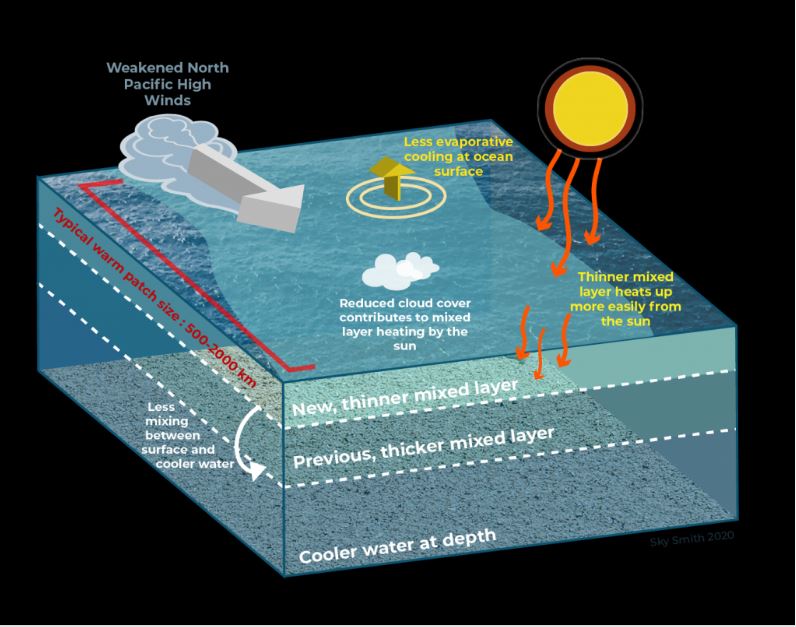
MHWs form when the ocean’s natural cooling mechanisms break down. This is driven by both atmospheric and oceanic factors:
- Weakening Winds: Strong winds normally cool the ocean via evaporation and by mixing the warm upper layer with cooler, deeper waters. When winds fail, this mixing stops.
- Ocean Stratification: Without wind-driven mixing, the top layer of the ocean becomes thin and "trapped."
- Solar Heating: This thin surface layer absorbs solar radiation rapidly. Because it cannot transfer heat to the depths, the temperature spikes, creating localized extreme heat.
- Global Drivers: Climate change ensures the oceans absorb 90% of excess global heat. Events like El Niño and shifts in atmospheric pressure (e.g., the North Pacific High) further trigger these massive pools of warm water.
How MHWs "Supercharge" Tropical Cyclones
The most critical takeaway for disaster management is the role of MHWs in Rapid Intensification (RI).
- Fueling the Engine: Tropical cyclones draw energy from the evaporation of warm ocean water. Passing over an MHW is like a car hitting a "gas station"; it provides an abundance of energy that boosts wind speeds by 20% and rainfall by 12%.
- Stalling and Decay: These "supercharged" storms tend to move more slowly over land and decay at a much lower rate, leading to catastrophic flooding.
- Economic Fallout: MHW-influenced cyclones are 1.6 times more likely to become billion-dollar disasters. This was evidenced by the back-to-back devastation of Hurricanes Helene and Milton in late 2024, where record-high sea surface temperatures in the Gulf of Mexico led to unprecedented destruction.
Ecological and Economic Implications
Beyond storm intensification, MHWs trigger a cascade of environmental crises:
- Ecosystem Collapse: MHWs are the primary cause of massive coral bleaching and the death of kelp forests, which are vital carbon sinks.
- Harmful Algal Blooms (HABs): Toxic algae thrive in warm water. These blooms produce neurotoxins like domoic acid, which contaminate the food chain and force the closure of commercial fisheries.
Biodiversity Loss: While some species migrate north ("the Winners"), cold-water species like salmon face mass die-offs ("the Losers").