
Aspero
- 22 Apr 2026
In News:
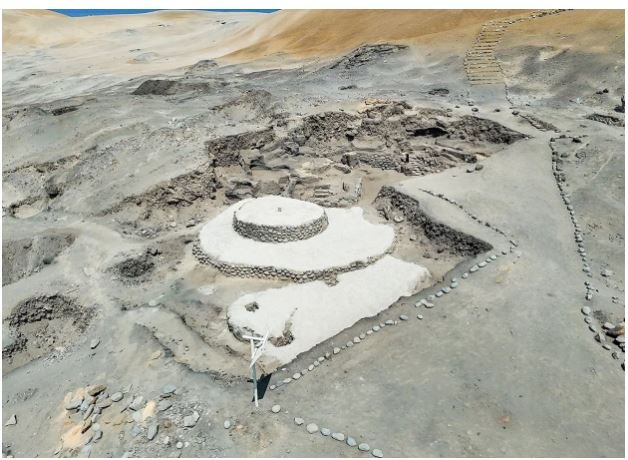
In a landmark finding for pre-Columbian history, archaeologists in Peru have recently uncovered an architectural structure at Áspero specifically designed for celestial observation. This discovery provides unprecedented insight into the early scientific prowess of the Caral Civilization (Norte Chico), one of the oldest known urban societies in the Americas.
The Maritime Capital of Caral
Áspero serves as a coastal counterpart to the Sacred City of Caral. Located on the right bank of the Supe River, just 500 meters from the Pacific Ocean, it functioned as the primary fishing and marine supply hub for the inland urban centers of the Supe Valley.
- Timeline: Occupied during the Late Archaic (Preceramic) period, approximately 3000 BC to 1800 BC.
- Civilizational Link: It is a key site of the Norte Chico/Caral-Supe civilization, characterized by its monumental architecture without the use of ceramics.
- Social Complexity: The site features 25 architectural complexes, including platform mounds and sunken circular plazas, reflecting a highly organized society capable of large-scale cooperative labor.
The Discovery: An Ancient Observatory
The newly identified structure, located in Sector J1, represents a specialized "astronomical center." This find confirms that the inhabitants of Áspero were not just expert fishers but also early scientists who mastered the observation of natural cycles.
Key Features of the Structure:
- Strategic Positioning: The observatory is situated near the settlement's main pyramid buildings. From this elevated vantage point, there is a clear, unobstructed view of both the coastline and the lower Supe Valley.
- Dual-Level Design: Unlike similar astronomical markers found in inland Caral, the Áspero observatory is a two-level structure. Researchers suggest this design was specifically tailored to its coastal location to monitor maritime and riverine phenomena simultaneously.
- The Shadow Effect: Constructed using rounded stones and pebbles bound with clay, the structure was engineered to cast specific shadows on its surfaces. By tracking these shadows, the ancient inhabitants could determine the cycles and movements of the sun, moon, and stars.
Functional Significance: Science in Service of Survival
The ability to "read the sky" was not merely a ritualistic endeavor; it was a critical tool for sustainable environmental management:
- Predicting Tides: Precise astronomical knowledge allowed the Caral people to predict tide changes, essential for their primary industry—fishing and shellfish gathering.
- Climate and Agriculture: While Áspero was maritime-focused, it engaged in intensive trade with agricultural inland sites. Monitoring celestial cycles helped predict El Niño events and the seasonal drying of the Supe River (which occurs between April and November), facilitating food security through exchange.
- Ritual and Governance: Such scientific knowledge likely reinforced the authority of the elite. Notable finds like the Lady of the Four Tupus and high-status child burials indicate a stratified society where "knowledge-keepers" held significant power.
Global and Comparative Significance
The discovery at Áspero challenges the notion that complex science only followed the advent of agriculture. It supports the "Maritime Foundations of Andean Culture" theory, suggesting that abundant marine resources provided the caloric surplus necessary to support a class of people dedicated to architecture, trade, and astronomy.
- Comparative Link: This observatory mirrors structures in the Sacred City of Caral, proving a unified civilizational knowledge system across the Supe Valley.
- Advanced Urbanism: The presence of such specialized scientific infrastructure 5,000 years ago places the Caral Civilization on par with the early civilizations of Mesopotamia, Egypt, and the Indus Valley.