
SagarmalaProgramme
- 14 Apr 2026
In News:
The maritime sector is the lifeline of India’s economy, with a vast coastline of 11,099 km and approximately 14,500 km of navigable waterways. Currently, maritime routes handle 95% of India’s trade by volume and 70% by value. To leverage this natural advantage, the Government of India launched the SagarmalaProgramme in March 2015, aiming to transform the nation through port-led development.
Vision and Strategic Pillars
The program is designed to reduce logistics costs, enhance trade competitiveness, and improve the lives of coastal communities. It operates through 5 Strategic Pillars across 24 categories:
- Port Modernization & New Port Development: Upgrading existing infrastructure and building new "Greenfield" ports to expand capacity.
- Port Connectivity Enhancement: Integrating ports with the hinterland via multimodal transport, including heavy-haul rail and expressways.
- Port-Led Industrialization: Establishing industrial clusters and Coastal Economic Zones (CEZs) near ports to minimize domestic logistics costs.
- Coastal Community Development: Focused on skill development, sustainable fisheries, and coastal tourism.
- Coastal Shipping & Inland Waterways: Shifting cargo from congested road/rail networks to more eco-friendly water-based transport.
Implementation Progress (As of March 2026)
The scale of Sagarmala is immense, involving a total of 845 projects with an estimated investment of ?6.06 lakh crore.
- Completed: 315 projects (?1.57 lakh crore).
- In Progress: 210 projects.
- Planning Stage: 320 projects.
Key Performance Indicators (FY 2025–26)
- Cargo Handling: Major ports handled a record 915.17 million tonnes (MT), reflecting a 7.06% year-on-year growth.
- Efficiency: Average vessel turnaround time dropped from 96 hours (2014) to 49.5 hours (2025).
- Waterway Growth: Inland waterway cargo movement surged by 700%, from 18.10 MTPA in 2014 to 145.50 MTPA in 2025.
- Global Standing: 9 Indian ports now rank in the Global Top 100, with Visakhapatnam Port breaking into the Top 20 for container traffic.
Socio-Economic Impact
- Urban Connectivity: 17 Ro-Pax and ferry projects are operational. For instance, the Ghogha–Hazira service reduced travel time from 10 hours (road) to 4 hours (sea).
- Livelihoods: 11 fishing harbor projects have been completed, benefiting 30,000 fishermen.
- Employment: The program has an estimated cumulative potential to create 1 crore jobs (40 lakh direct, 60 lakh indirect).
- Skill Development: Over 7,600 candidates trained under the DDU-GKY convergence, with many placed directly in maritime sectors.
Institutional Framework
A robust multi-tier governance structure ensures coordinated execution between the Union and State governments:
- National Sagarmala Apex Committee (NSAC): Provides overall policy guidance and oversight.
- Maritime States Development Council (MSDC): Facilitates critical Centre-State coordination.
- State Sagarmala Committees (SSCs): Responsible for project identification and monitoring at the state level.
- Sagarmala Finance Corporation Limited (SMFCL): Restructured in June 2025 (formerly SDCL), SMFCL is India’s first NBFC dedicated to the maritime sector, addressing the financing gap with loan sanctions already reaching ?4,300 crore.
The Future: Sagarmala 2.0 & Amrit Kaal
Building on the foundation of the initial phase, Sagarmala 2.0 aligns with the Maritime India Vision (MIV) 2030 and Maritime Amrit Kaal Vision 2047.
- Budgetary Support: Proposed at ?85,482 crore.
- Investment Target: Aims to catalyze ?3.6 lakh crore in total investment.
- Core Focus: Deepening modernization, fostering maritime innovation, and achieving the goal of Viksit Bharat 2047 by making India a global maritime hub.
SagarmalaProgramme
- 21 Mar 2025
In News:
The SagarmalaProgramme, launched by the Ministry of Ports, Shipping & Waterways (MoPSW) in 2015, aims to revolutionize India’s maritime sector by focusing on port-led development, logistics optimization, and coastal economic growth. With a 7,500 km coastline and strategic positioning on global trade routes, India is set to leverage its maritime potential for sustainable economic development.
Key Components of the SagarmalaProgramme
- Port Modernization & New Port Development: Upgrading existing ports and constructing new ones to enhance operational capacity, reduce bottlenecks, and improve efficiency.
- Port Connectivity Enhancement: Fostering seamless multi-modal logistics, including inland waterways and coastal shipping, to optimize time and cost of cargo transportation.
- Port-Led Industrialization: Establishing industrial clusters near ports, boosting economic growth while minimizing logistics costs.
- Coastal Community Development: Focusing on the sustainable development of coastal communities, through skill development, livelihood generation, and fisheries enhancement.
- Coastal Shipping & Inland Waterways Transport: Promoting eco-friendly cargo transportation via coastal and inland waterways to alleviate road and rail congestion.
Key Achievements and Outcomes
- Project Implementation: 839 projects worth ?5.79 lakh crore have been identified, with 272 projects already completed, amounting to ?1.41 lakh crore in investments.
- Growth in Coastal Shipping: Coastal shipping has surged by 118% over the last decade, significantly reducing logistics costs and emissions.
- Increased Inland Waterway Cargo: A 700% increase in inland waterway cargo, reducing congestion on roadways and railways.
- Improved Global Maritime Standing: Nine Indian ports now rank among the world’s top 100, with Vizag among the top 20 container ports globally.
Sagarmala 2.0 and Strategic Initiatives
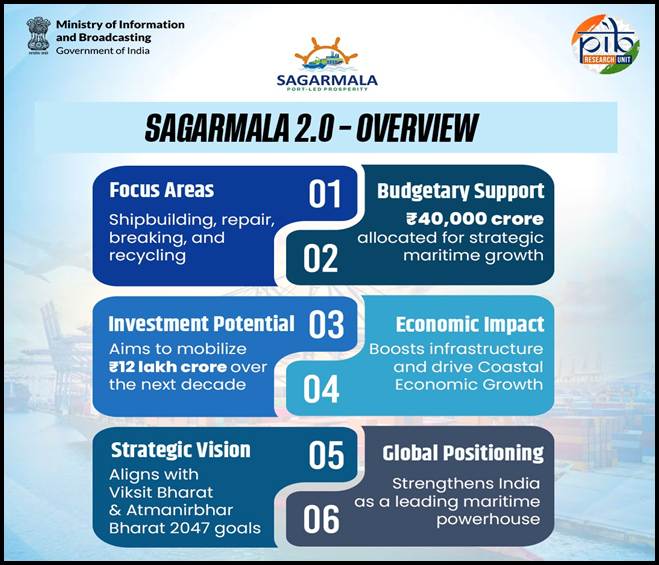
- Sagarmala 2.0, launched with a ?40,000 crore budgetary support, aims to position India among the top five shipbuilding nations by 2047.
- It introduces a focus on shipbuilding, repair, recycling, and further port modernization, which will help India become a global maritime hub.
- The initiative targets a shipbuilding capacity of 4 million GRT and an annual port handling capacity of 10 billion metric tons.
- Additionally, the Sagarmala Startup Innovation Initiative (S2I2), launched in March 2025, seeks to promote innovation, research, and startups in the maritime sector.
- The program emphasizes green shipping, smart ports, and sustainable coastal development, providing funding, mentorship, and industry partnerships to boost technological advancement in the sector.
Funding and Project Implementation
- The SagarmalaProgramme follows a strategic and stakeholder-driven approach, involving central ministries, state governments, major ports, and other agencies.
- The funding structure utilizes a combination of public-private partnerships (PPP), internal resources of MoPSW agencies, and grant-in-aid for high-social-impact projects.
- The establishment of the Sagarmala Development Company Limited (SDCL) facilitates equity participation in key projects.
Future Outlook and Alignment with Vision 2047
Sagarmala 2.0 and its strategic initiatives are aligned with the Maritime Amrit Kaal Vision 2047 (MAKV), which aims to make India a leader in global maritime affairs. By enhancing port efficiency, expanding shipbuilding capacity, and fostering innovation, these initiatives will support India's vision of a Viksit Bharat (developed India) and Atmanirbhar Bharat (self-reliant India) by 2047.