
Natural History Museum (Mizoram) Declared as India's 21st Designated Repository
- 10 Jul 2026
In News:
The Ministry of Environment, Forest and Climate Change (MoEFCC), on the recommendation of the National Biodiversity Authority (NBA), has notified the Natural History Museum (NHM), Mizoram as India's 21st Designated Repository under the Biological Diversity Act, 2002.
What are Designated Repositories?
Designated Repositories are institutions officially recognized under the Biological Diversity Act, 2002 for the safe preservation, maintenance and authentication of biological specimens accessed under the provisions of the Act. They serve as permanent scientific repositories for biological materials, ensuring proper documentation, traceability and long-term availability for research, taxonomy and conservation.
These repositories also preserve voucher specimens and type specimens of newly discovered species, which serve as standard references for species identification and future scientific studies.
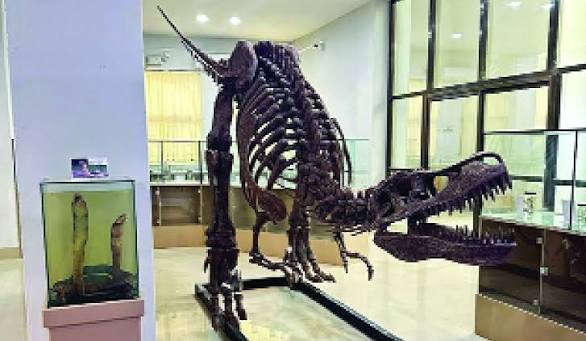
Natural History Museum (NHM), Mizoram
The Natural History Museum (NHM) was established in 2022 under Mizoram University, a Central University. Situated within the Indo-Burma Biodiversity Hotspot, the museum occupies a region recognized globally for its exceptional biological diversity and high level of endemism.
As a Designated Repository, NHM will preserve authenticated specimens of important plant and animal groups, including pteridophytes, macrofungi, reptiles, amphibians, freshwater fishes, moths, beetles and butterflies. It will also function as the official repository for type specimens of newly discovered species from the region, thereby strengthening taxonomic research and biodiversity documentation.
Significance
The designation of NHM as India's 21st Designated Repository strengthens the country's biodiversity governance framework by expanding scientific infrastructure for ex situ conservation. The repository will facilitate accurate species identification, long-term preservation of biological resources and ecological restoration following habitat degradation, natural disasters or species decline.
The initiative is particularly significant because Mizoram and the North-Eastern Region together support more than 7,500 species of flowering plants and over 2,000 faunal species, making the region one of India's richest biodiversity landscapes.
The notification also advances National Biodiversity Target 4 under India's National Biodiversity Strategy and Action Plan (NBSAP) 2024–2030 and contributes to the implementation of the Kunming–Montreal Global Biodiversity Framework, which emphasizes strengthening ex situ conservation alongside in situ conservation.
Mizoram Ginger Mission
- 16 May 2026
In News:
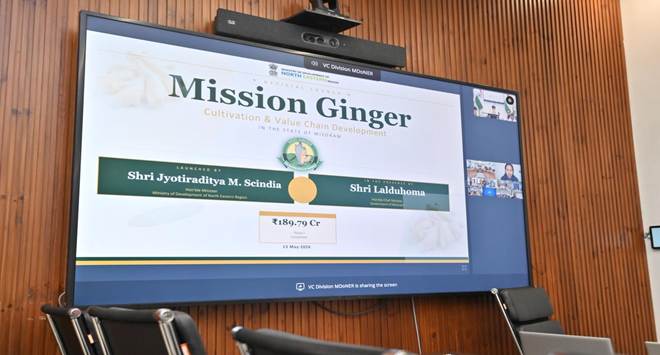
The Ministry of Development of North Eastern Region (MDoNER), along with the Government of Mizoram, has launched the ?189.79 crore Mizoram Ginger Mission (also designated as the Mizoram Ginger Unique Selling Proposition (USP) – Sustainable Cultivation & Value Chain Development Project).
The initiative utilizes a multi-ministerial convergence model to move away from fragmented departmental schemes. It pools the administrative resources of the Ministries of Agriculture & Farmers Welfare, Rural Development, and Food Processing Industries, alongside critical institutional stakeholders like NABARD (rural credit and cooperative development), ICAR (scientific inputs), and APEDA (export protocols and international logistics).
Core Economic Rationale: Quality vs. Value Disparity
The Superior Quality Profile
Mizoram holds a distinct natural edge in ginger cultivation, leading NITI Aayog to designate it as the “Ginger Capital of India.”
- Genetic Advantage: The state grows indigenous, premium varieties—most notably Thingpui and Thinglaidum—both of which secured Geographical Indication (GI) certification.
- Chemical Distinctiveness: Mizo ginger is premium, pharma-grade ginger due to its exceptionally high oleoresin content of 6% to 8% (the concentrated compound responsible for flavor, aroma, and medicinal properties). This is more than double the global baseline average of approximately 3%.
The Price Disparity Paradox
Despite producing world-class agricultural raw materials, local cultivators face severe market exploitation:
- The Valuation Gap: Farmers traditionally receive just ?8 to ?15 per kg at the farm gate. In contrast, the processed commodity commands upwards of ?500 per kg on international retail shelves.
- The Cause: This gap stems from high post-harvest handling losses, a complete lack of regional processing units, and a dependence on long networks of informal middlemen.
Structural Interventions: The Four Strategic Pillars
To build a sustainable agrobusiness ecosystem, the project operates as a structural "movement" built on four functional pillars:
- Convergence: Aligning existing central public funds (such as a dedicated ?30.13 crore allocation via the North Eastern Council’s Focused Development Component) to build infrastructure efficiently.
- Value Addition: Transitioning the local economy from selling raw, perishable ginger to manufacturing high-margin derivatives like dried ginger flakes, fine powders, and distilled pharmaceutical oleoresins.
- Branding: Marketing the product globally based on its certified origin, low fiber content, high chemical potency, and chemical residue-free composition.
- Market Integration: Directly connecting local farmers with institutional pharmaceutical houses, nutraceutical enterprises, and international buyers.
Hub-and-Spoke Infrastructure Layout
To manage logistical challenges in the hilly terrain, the mission deploys a coordinated Hub-and-Spoke model to support nearly 20,000 farming households:
- The Core Processing Hub: Established at Mualkawi in the Champhai District, this central facility handles advanced high-tech processing, mechanized peeling, industrial dehydration, and extraction.
- The Spoke Centers: Three dedicated satellite units are positioned at Tualcheng, Vaphai, and Zotlang to handle initial sorting, cleaning, grading, and slicing. This primary processing reduces transport weight and minimizes post-harvest rot.
- Ancillary Focus Areas: The project integrates more than 30 targeted interventions covering field mechanization, the introduction of solarized storage units, strict food safety controls, and blockchain-backed farm-to-fork traceability.
Macro Policy Implications: "Brand North East"
The mission is an operational component of MDoNER's broader "Brand North East" regional development strategy. This macro policy assigns specific agro-climatic Unique Selling Propositions (USPs) to individual states to foster specialized production:
- Sikkim: India's premier 100% Organic State.
- Meghalaya: Global hub for high-curcumin Lakadong Turmeric.
- Tripura: Mass export center for Queen Pineapple.
- Arunachal Pradesh: Large-scale commercialization of Kiwi fruit.
- Nagaland: High-altitude, specialty Coffee plantations.
- Mizoram: Globally integrated source for premium Pharma-Grade Ginger.
Through this structured value-chain integration, the mission aims to "disintermediate the intermediary" via robust Farmer Producer Organizations (FPOs), targeting a six-fold increase in net income realization for local farmers while exporting directly into quality-sensitive markets across South-East Asia, the Middle East, and Europe.
Statehood Day of Mizoram and Arunachal Pradesh

- 21 Feb 2026
In News:
On 20 February every year, India commemorates the grant of statehood to Arunachal Pradesh and Mizoram, both of which became full-fledged States of the Indian Union in 1987. The Prime Minister extended greetings to the people of both States on the occasion, highlighting their cultural richness and contribution to national unity.
Constitutional Basis of Statehood
- 53rd Constitutional Amendment Act, 1986 - Granted statehood to Mizoram.
- 55th Constitutional Amendment Act, 1986 - Granted statehood to Arunachal Pradesh.
- Both States formally came into existence on 20 February 1987.
- Mizoram became the 23rd State, while Arunachal Pradesh became the 24th State of India.
Mizoram
Historical Background
- Originally known as the Lushai Hills district of Assam.
- Renamed Mizo Hills in 1954.
- Became a Union Territory in 1972.
- Achieved statehood following the Mizoram Peace Accord signed in 1986 between the Government of India and the Mizo National Front (MNF).
The Accord ended years of insurgency and paved the way for political stability and democratic integration.
Constitutional Protection
- Recognized as a “Tribal Area” under the Sixth Schedule (Article 244(2)) of the Constitution.
- Provides for Autonomous District Councils (ADCs) to safeguard tribal customs, land rights, and local governance.
Arunachal Pradesh
Historical Evolution
- Earlier known as the North-East Frontier Agency (NEFA).
- Came under British control after the Treaty of Yandaboo (1826), following the First Anglo-Burmese War (1824–26).
- The 1914 Shimla Convention demarcated the boundary between Tibet and NEFA, resulting in the McMahon Line.
- Until 1962, it was constitutionally under Assam.
- Became a Union Territory in 1972.
- Granted full statehood in 1987 through the 55th Constitutional Amendment.
Strategic Significance
- Shares an international boundary with China (Tibet Autonomous Region).
- Holds immense strategic and geopolitical importance in India’s North-East security framework.
Mizoram Becomes India’s First Fully Literate State
- 22 May 2025
In News:
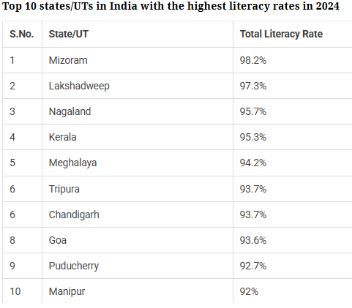
Mizoram has officially become India’s first fully literate state, attaining a literacy rate of 98.2% according to the Periodic Labour Force Survey (PLFS) 2023–24. This achievement surpasses the 95% threshold defined by the Ministry of Education to classify a region as fully literate.
Definition of Literacy
- As per the Office of the Registrar General of India, a literate person is someone aged 7 years or above who can read and write with understanding in any language.
- Under NEP 2020 and in alignment with SDG 4.6, the definition has expanded to include the ability to read, write, and compute with comprehension, and includes digital and financial literacy and critical life skills.
India’s Literacy Landscape (2023–24)
- National Literacy Rate: 80.9% (age 7+)
- Mizoram: 98.2% (Highest; now declared fully literate)
- Ladakh: First UT to achieve full functional literacy under ULLAS
- Lowest Literacy Rates: Andhra Pradesh (72.6%), Bihar (74.3%)
ULLAS – Nav Bharat SaakshartaKaryakram
The achievement is attributed to the ULLAS (Understanding Lifelong Learning for All in Society)programme, a centrally sponsored scheme running from 2022 to 2027, aligned with the National Education Policy (NEP) 2020.
Key Features:
- Target Group: Adults aged 15 years and above who missed formal education.
- Implementation: Based on volunteerism and the principle of Kartavya Bodh (sense of duty).
- Components:
- Foundational Literacy and Numeracy
- Critical Life Skills (including digital, legal, financial literacy)
- Basic Education
- Vocational Skills Development
- Continuing Education
- Assessment: Foundational Literacy and Numeracy Assessment Test (FLNAT) is conducted periodically for certification.
- Digital Tools: Resources provided through the DIKSHA platform and the ULLAS mobile/web portal in regional languages.
What is Functional Literacy?
Functional literacy refers to an individual's ability to apply reading, writing, and numeracy in daily tasks, enabling personal development and community participation.
Other Key Educational Initiatives
- PM SHRI Schools
- Sarva Shiksha Abhiyan
- PRAGYATA (Digital Education)
- Mid-Day Meal Scheme
- BetiBachaoBetiPadhao
- National Programme on Technology Enhanced Learning (NPTEL)
Reimposition of Protected Area Permit (PAP) in Manipur, Mizoram, and Nagaland

- 20 Dec 2024
In News:
The Ministry of Home Affairs (MHA) of the Government of India has recently reinstated the Protected Area Regime (PAR) for the states of Manipur, Mizoram, and Nagaland, which are strategically located along the international border with Myanmar. This move comes amid growing security concerns, particularly the influx of migrants from Myanmar, which has been cited as a significant factor in the ongoing conflicts in the region.
What is Protected Area Permit (PAP)?
A Protected Area Permit (PAP) is a special permission required for foreign nationals to visit certain areas of India deemed sensitive due to their proximity to international borders or other security-related concerns. The regulations governing the PAP are laid down under the Foreigners (Protected Areas) Order, 1958, which restricts the entry of foreigners to designated regions within India.
Purpose of PAP:
The PAP regime serves multiple critical objectives:
- National Security: It ensures the monitoring and regulation of foreign nationals in sensitive border areas.
- Preservation of Local Communities: The regime safeguards indigenous populations and their unique cultural heritage.
- Environmental Conservation: The permit helps minimize ecological disturbances in fragile regions, ensuring sustainable tourism and development.
Key Features of PAP Regime:
- Eligibility: All foreign nationals, excluding Bhutanese citizens, must obtain a PAP to enter these designated areas. The permit can be granted for specific regions, routes, and time periods.
- Validity: The PAP is typically valid for 10 days with the possibility of extension.
- Restricted Areas: Certain foreign nationals, particularly those from Afghanistan, China, and Pakistan, require prior approval from the MHA to enter these regions.
- Tourism and Other Permits: While foreign nationals can visit these regions for tourism purposes under the PAP, non-touristic visits require special permission from the MHA.
- Registration: Foreigners must register with the Foreigners Registration Officer (FRO) within 24 hours of arrival in the protected area.
Historical Context and Reimposition:
The PAP regime was lifted for Manipur, Mizoram, and Nagaland in 2011, as part of efforts to boost tourism in the region. However, due to rising security concerns related to illegal immigration and ethnic tensions, the MHA reimposed the PAP in 2025. The government’s move aligns with its broader national security strategy to better control foreign movements in sensitive border regions, particularly those with Myanmar, where the Free Movement Regime (FMR) had previously allowed easier cross-border travel.
Background on Security Concerns:
The influx of individuals from Myanmar, particularly members of the Chin community, which shares ethnic ties with the Kuki-Zomi communities in India, has been a source of tension. The Manipur government has repeatedly emphasized that uncontrolled migration has contributed to the unrest in the state. Additionally, the decision to end the FMR between India and Myanmar has further intensified the debate over border security and migration.
Impact on Tourism and Local Communities:
While the reimposition of the PAP is seen as a measure to strengthen security, it has raised concerns in states like Mizoram and Nagaland, which have been actively promoting tourism. For example, Nagaland’s Hornbill Festival recently attracted over 200,000 visitors, including foreign nationals. The reintroduced restrictions may dampen tourism in these states, which were previously exempt from the PAP to encourage foreign visits.
Key Legal Provisions Under the PAP Regime:
- Foreigners (Protected Areas) Order, 1958: This order mandates the requirement of a PAP for foreigners visiting areas close to international borders.
- Foreigners (Restricted Areas) Order, 1963: This order covers areas that require a Restricted Area Permit (RAP) for foreign nationals, such as the Andaman and Nicobar Islands.
States Affected by the PAP Regime:
The PAP regime affects regions close to India’s international borders, including the entire states of Arunachal Pradesh, Sikkim, Manipur, Mizoram, Nagaland, and parts of Himachal Pradesh, Jammu & Kashmir, Rajasthan, and Uttarakhand.