
Hoysala Temples of Karnataka
- 24 Feb 2026
In News:
Hoysala architecture (1050–1300 CE) is best known for its star-shaped (stellate) temple plans, soapstone carvings, and hybrid Vesara style blending Nagara and Dravida features.
Historical Background – Hoysala Dynasty
- Period: c. 11th–14th century CE
- Initially feudatories of the Western Chalukyas (Kalyana Chalukyas), later emerged as an independent power.
- Founder: Nripa Kama II (early phase as vassal).
- Capitals:
- Initially Belur
- Later shifted to Dwarasamudra (modern Halebidu)
- Ruled large parts of present-day Karnataka and parts of Tamil Nadu for over three centuries.
Notable Rulers
- Vishnuvardhana (Bittideva) – Major territorial expansion; prolific temple patronage; converted from Jainism to Vaishnavism under the influence of Ramanuja.
- Veera Ballala II
- Veera Ballala III
Architectural Style: Vesara Tradition
Hoysala architecture represents the Vesara style, a hybrid blending:
- Nagara (North Indian) features
- Dravida (South Indian) features
It evolved into a distinct regional idiom in Karnataka.
Core Architectural Features
1. Building Material
- Chloritic schist (soapstone)
- Soft when quarried → allows intricate carving
- Hardens over time
- Enabled microscopic detailing (ornaments, curls, fingernails)
2. Ground Plan Variations
- Ekakuta – Single shrine
- Dvikuta – Two shrines
- Trikuta – Three shrines
- Chatushkuta / Panchakuta – Four or five shrines
Most temples stand on a raised jagati (platform) with a stellate (star-shaped) plan, producing rhythmic projections and recesses.
Distinctive Feature: Unlike the cruciform Panchayatan layout, Hoysala temples maximize sculptural surface through multiple star-shaped projections.
3. Sculptural Ornamentation
- Outer walls resemble sculptural manus.
- Horizontal friezes depict:
- Elephants (strength)
- Horses
- Mythical beasts
- Episodes from Ramayana, Mahabharata, Puranas
- Bracket figures: Madanikas (celestial dancers)
- Detailed jewellery and costumes carved in stone.
4. Shikhara (Superstructure)
- Tiered arrangement with horizontal mouldings.
- Interconnected chambers crowned by proportionate towers.
- Harmonious vertical elevation.
Important Hoysala Temples
1. Chennakeshava Temple
- Located at Belur.
- Commissioned by King Vishnuvardhana after victory over the Cholas.
- Dedicated to Vishnu.
- Known for exquisite bracket figures (madanikas).
- Inscribed under UNESCO (2023).
2. Hoysaleswara Temple
- Grand Shiva temple at Halebidu.
- Elaborate narrative friezes and mythological panels.
- One of the most sculpturally dense monuments.
- UNESCO inion (2023).
3. Keshava Temple
- 13th-century Trikuta Vaishnava temple.
- Built by Somanatha Dandanayaka under Narasimha III.
- Exemplifies mature Hoysala detailing.
- UNESCO inion (2023).
Other Important Monuments (Prelims Focus)
- Veera Narayana Temple (c. 1200 CE) – Large ranga-mandapa, interior emphasis.
- Nageshwara & Govindeshwara Temples (Koravangala) – Transitional phase from Chalukyan to mature Hoysala style.
- Bucheshwara Temple (1173 CE) – High sculptural density; star-shaped platform.
- Lakshminarasimha Temple (1250 CE, Javagal) – Trikuta shrine; polished pillars.
- Lakshmidevi Temple (1114 CE) – Early experiment; rare Mahakali shrine; patronized by merchant Sahaja Devi.
- Panchalingeshwara Temple (Mandya) – Rare Panchakuta design (five east-facing Shiva shrines).
- Jain Basadis at Halebidu – Parshvanatha, Shantinatha, Adinatha; restrained aesthetic.
- Hulikere Kalyani – 12th-century stepped tank integrating cosmological symbolism.
UNESCO Recognition
In 2023, the following were inscribed as “Sacred Ensembles of the Hoysalas” during the 45th World Heritage Committee session:
- Chennakeshava Temple (Belur)
- Hoysaleswara Temple (Halebidu)
- Keshava Temple (Somanathapura)
Karnataka Hate Speech and Hate Crimes (Prevention) Bill, 2025

- 12 Dec 2025
In News:
Karnataka has introduced the first state-level legislation in India specifically aimed at tackling hate speech and hate crimes. The move highlights a long-standing legal gap although the term “hate speech” is widely used, Indian criminal law does not formally define it.
What is Hate Speech?
According to the 267th Report of the Law Commission (2017), hate speech includes words, signs, or visible representations intended to incite hatred, discrimination, or violence against individuals or groups based on identity markers such as religion, caste, race, gender, or sexual orientation.
Constitutional Context
- Article 19(1)(a) guarantees freedom of speech and expression.
- Article 19(2) allows reasonable restrictions in the interests of public order, morality, sovereignty, defamation, and incitement to offences.
Thus, hate speech regulation must balance free expression and social harmony.
Existing Legal Framework in India
India currently regulates hate speech through scattered provisions, mainly focused on public order:
Under the Bharatiya Nyaya Sanhita (BNS), 2023
- Section 196 (earlier IPC 153A): Promoting enmity between groups and acts prejudicial to harmony.
- Section 299 (earlier IPC 295A): Deliberate acts intended to outrage religious feelings.
- Section 353: Statements or misinformation inciting offences or disturbing public order.
These offences are cognisable, allowing arrest without warrant, and usually carry punishment up to three years.
Other Relevant Laws
- Representation of the People Act, 1951 – Disqualification for certain hate-related offences.
- SC/ST (Prevention of Atrocities) Act, 1989 – Penalises caste-based insults and humiliation.
- Protection of Civil Rights Act, 1955 – Addresses promotion of untouchability.
Digital Dimension
Section 66A of the IT Act, 2000 was widely used for online speech but was struck down in Shreya Singhal v. Union of India for being vague and unconstitutional.
Supreme Court’s Approach
The Supreme Court of India has increasingly intervened:
- Shaheen Abdulla v. Union of India – Directed police to take suo motu action on hate speech.
- Tehseen S. Poonawalla v. Union of India – Mandated nodal officers to prevent mob violence.
- Later observations stressed that implementation failures, not legal vacuum alone, are the key challenge.
Karnataka Hate Speech and Hate Crimes (Prevention) Bill, 2025
Key Features
- Clear Definition of Hate Speech: Expression causing injury or disharmony against a person or group based on:Religion, Race, Caste, Gender, Sexual orientation, Place of birth and Disability
- Inclusion of gender and sexual orientation expands protection beyond current BNS scope.
- Collective Liability: If hate speech is committed through an organisation, office bearers or responsible persons can also be held liable.
- Online Regulation: State government empowered to block or remove hateful online content, addressing digital propagation.
- Stringent Punishment
- First offence: 1–7 years imprisonment + ?50,000 fine
- Repeat offence: 2–10 years imprisonment + ?1 lakh fine
- Offences are cognisable and non-bailable
- Victim Compensation: Mandates adequate compensation for victims.
- Public Good Exception: Books, art, research, or material published in good faith for public interest may be exempt.
Past Attempts to Define Hate Speech
- Law Commission 267th Report (2017) – Proposed IPC Sections 153C & 505A.
- Private Member’s Bill (2022) in Rajya Sabha sought a comprehensive definition but was not enacted.
- Committees like Viswanathan (2015) and Bezbaruah (2014) also suggested legal reforms.
Significance of the Karnataka Bill
- First dedicated state law on hate speech
- Attempts to shift focus from public order to dignity and equality
- Recognisesdigital hate propagation
- Expands protection to LGBTQ+ communities and persons with disabilities
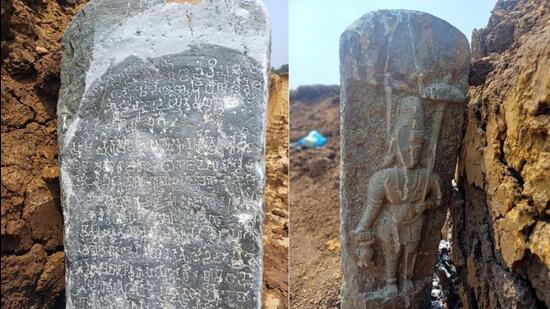
Rare 7th-Century Old Kannada Inscription unearthed at Madapura Lake, Karnataka
- 07 May 2025
In News:
A rare 7th-century Old Kannada inscription from the reign of Vikramaditya I of the Badami Chalukyas has been discovered at Madapura Lake in Davangere, Karnataka. The inscription sheds light on taxation, land grants, and regional governance during his rule.
About the Badami Chalukyas
- Origins: Emerged as a regional Kannada power claiming descent from Ayodhya to establish legitimacy.
- Capital:Vatapi (present-day Badami, Karnataka).
- Notable Rulers and Political History:
- Pulakesin I (543–566 CE): Founder of the dynasty; fortified Badami.
- Pulakesin II (609–642 CE): Most celebrated ruler; defeated Harshavardhana at the Narmada river; established diplomatic contacts with Persia (depicted in Ajanta caves).
- Vikramaditya I (644–681 CE): Son of Pulakesin II; reclaimed Badami from Pallavas and expanded influence over southern kingdoms like the Cholas, Pandyas, and Keralas.
- Administration:
- Centralised monarchy with limited autonomy granted to villages.
- Economy relied on land revenue and military conquests.
- Maintained a naval fleet—Pulakesin II had around 100 ships.
- Religion:Patronised Shaivism, Vaishnavism, Shaktism, and Jainism. Vikramaditya I and others made donations to Jain institutions; Pulakesin I performed Ashvamedha Yajna.
- Art and Architecture:
- Developed the Vesara style, a fusion of northern Nagara and southern Dravida temple architecture.
- Constructed rock-cut and structural temples in Aihole, Badami, and Pattadakal.
About Vikramaditya I
- Background: Son of Pulakesin II; ascended the throne during a period of political turmoil following his father's death and Pallava invasion.
- Military Achievements:
- Defeated Narasimhavarman I of the Pallavas, who had earlier seized Badami.
- Reunited the fractured Chalukya empire, restoring its former prestige.
- Subdued southern powers including the Cholas, Pandyas, and Keralas, consolidating control over the southern Deccan.
- Political Consolidation:
- Re-established central authority across Karnataka and surrounding regions.
- Appointed loyal feudatories, such as Singhavenna (mentioned in the new Davangere inscription), to manage local governance.
- Legacy:
- Known by titles such as Rajamalla (King of Kings) and Yuddhamalla (Warrior King).
- His reign marked a revival of Chalukya power and paved the way for cultural and architectural achievements under his successors Vikramaditya II and Kirtivarman II.
Sannati: Ancient Buddhist Site
- 05 Apr 2024
Why is it in the News?
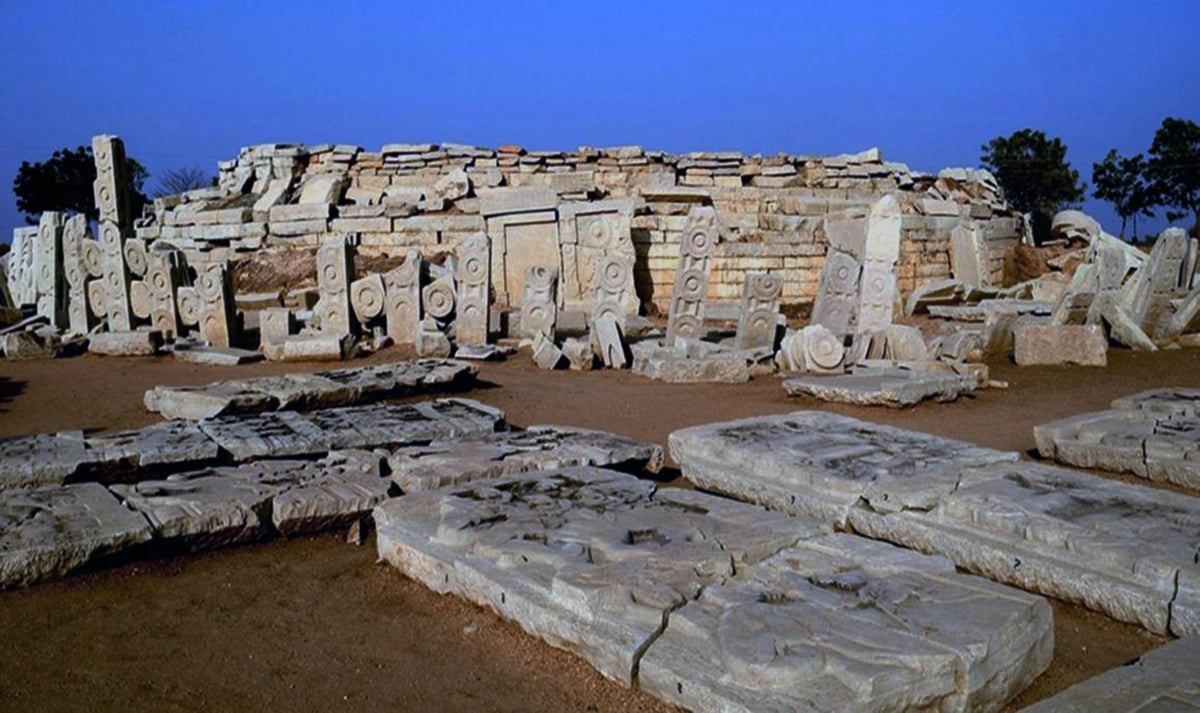
Left neglected for many years after it came to light through the ASI excavations in the 1990s, the ancient Buddhist site of Sannati on the bank of the Bhima River got a restoration project in 2022.
About Ancient Sannati Buddhist site:
- This ancient Sannati Buddhist site, situated alongside the Bhima River near Kanaganahalli in Karnataka's Kalaburagi district, offers a rich historical and cultural experience.
- Notably, it also boasts the Chandrala Parameshwari Temple, a popular attraction among tourists.
Key discoveries at this site include evidence of development across three distinct phases:
- Maurya, Early Satavahana, and Later Satavahana periods, span from the 3rd Century B.C. to the 3rd Century A.D.
- The Ranamandala area of Sannati presents a unique chronological timeline from prehistoric to early historic eras.
- Among the remarkable findings is an inscription in the Prakrit language, inscribed using Brahmi script.
- Noteworthy is the recovery of a significant stone sculpture portraying Mauryan Emperor Ashoka, surrounded by his queens and attendants, with the inscription "Raya Asoko" in Brahmi script, leaving no doubt about the identity of the depicted figure.
- The excavation also yielded around 60 dome slabs featuring sculptural depictions of Jataka stories, significant events in the life of Buddha, portraits of Shatavahana monarchs, and unique representations of Buddhist missionaries dispatched by Ashoka to various regions.
- Moreover, the ancient Nagavi Ghatikasthana, often dubbed as the Takshashila of the South, lies approximately 40 km from Sannati.
- Functioning as a prominent educational center akin to a modern-day university during the Rashtrakuta and Kalyana Chalukya dynasties from the 10th to 12th Centuries, it held great historical significance.
NAL Successfully Tested High Altitude Pseudo-Satellite (HAPS) at Challakere, Karnataka (TOI)

- 12 Feb 2024
Why is it in the News?
Scientists from city-based National Aerospace Laboratories (NAL), a Council of Scientific and Industrial Research (CSIR) lab, achieved a breakthrough by successfully testing an unmanned aerial vehicle called High-Altitude Pseudo Satellite (HAPS) at Chitradurga's Challakere in Karnataka.
News Summary:
- National Aerospace Laboratories (NAL) has achieved a milestone with the successful testing of an unmanned aerial vehicle known as the High Altitude Pseudo-Satellite (HAPS) in Challakere, Karnataka.
- This innovative system, measuring 5 meters in length with an impressive 11-meter wingspan and weighing 23 kg, soared to an altitude of approximately 3 km and maintained its position for an impressive duration of eight hours.
- A comprehensive series of tests is slated, with the ultimate goal of developing a full-fledged aircraft boasting a remarkable 30-meter wingspan comparable to a Boeing 737 by the year 2027.
- This advanced craft is anticipated to ascend to an impressive altitude of 23 km and remain airborne for a remarkable period of at least 90 days.
- NAL's ambitious agenda includes the design and construction of various components essential for the HAPS, including propellers, battery management systems, carbon-composite airframes, flight-control systems, and high-powered electric motors capable of withstanding extreme temperature variations.
- Additionally, in a separate endeavour, a Bengaluru-based private company recently conducted the inaugural test flight of a solar-powered, long-endurance drone, achieving an impressive flight duration of 21 hours.
About High Altitude Pseudo-Satellite (HAPS):
- Since the 1990s, numerous global initiatives have been undertaken to explore the potential applications of High Altitude Pseudo Satellites, also known as High Altitude Platform Stations (HAPS).
- Positioned above 20 km altitude in the stratosphere, these unmanned aircraft are designed for exceptionally long-duration flights, spanning months or even years.
- HAPS encompass various aircraft types, including airplanes, airships, and balloons.
Benefits/Advantages of HAPS:
- These solar-powered vehicles bridge the gap between unmanned aerial vehicles (UAVs) operating in lower altitudes and traditional satellites in space.
- They offer a wide array of applications, including telecommunications, emergency/public safety communications, intelligent transportation systems, maritime surveillance, environmental monitoring, and land border control.
- Compared to ground-based communication networks, HAPS can cover larger areas with minimal interference and facilitate data transfer between satellites and ground-based telecom networks.
- Unlike traditional satellites, which are costly to construct and launch, HAPS are more cost-effective and easier to deploy.
- It has both military and civilian applications, including intelligence, surveillance, telecommunication, and disaster response.
- The technology offers lower latency and can connect to multiple ground stations.
Significance for India:
- In India, Hindustan Aeronautics Limited (HAL) announced in 2022 its collaboration with a startup company to develop a "futuristic" high-altitude pseudo satellite.
- Given India's extensive land borders stretching approximately 15,000 km and a coastline spanning 7,500 km, securing these borders is paramount, necessitating diverse solutions.
- Hovering at the Earth's atmospheric edge, HAPS offer valuable services for efficient border surveillance, tracking enemy movements deep into territories or seas, and conducting round-the-clock missions.
- Equipped with advanced optical and infrared cameras, state-of-the-art sensors, and other sophisticated technology, these aerial platforms are ideal for border patrolling, target tracking, maritime surveillance, navigation, and even missile detection.
- China's Aviation Industry Corporation of China (AVIC), a state-owned aerospace and defense conglomerate, has been actively developing various HAPS platforms for surveillance purposes.
- In 2018, it successfully tested the solar-powered Morning Star drone, renowned for its prolonged airborne endurance.
Digital Detox for Responsible Gaming (TOI)

- 02 Feb 2024
Why is it in the News?
The Karnataka government recently said it would launch a 'Digital Detox' initiative in collaboration with the All India Game Developers Forum (AIGDF), with special emphasis on gaming and social media.
What is Digital Detox?
- A digital detox entails voluntarily refraining from using digital devices like smartphones, computers, and social media platforms for a defined period.
- This period can range from a few hours to as long as a week or even a month.
- Research indicates that approximately 25% of smartphone owners aged 18 to 44 cannot recall the last time they were separated from their phones.
Benefits:
- Overcoming Technology Addiction: Studies reveal that around 61% of individuals acknowledge their addiction to the internet and digital screens.
- A digital detox aids in combating this addiction.
- Enhanced Mental Health: Disconnecting from technology can alleviate stress and anxiety, thereby fostering improved mental health and overall well-being.
- Increased Productivity and Creativity: Taking a break from continuous digital engagement bolsters focus and concentration, leading to heightened productivity and creativity.
- Improved Sleep: Excessive screen time has been linked to poor sleep quality. A digital detox helps in promoting better sleep by reducing exposure to blue light and stimulating content.
- Enhanced Communication Skills: Reducing online time allows for more face-to-face interactions, nurturing better communication skills and social connections.
Challenges:
- Feelings of Disconnection: Detox participants may feel disconnected from friends and family members.
- Fear of Missing Out: Participants may experience FOMO (fear of missing out) or anxiety about missing important information.
- Boredom or Restlessness: Detoxes may lead to feelings of boredom or restlessness.
- Withdrawal Symptoms: Some individuals may experience withdrawal symptoms such as anxiety or boredom.
Way forward:
- Start Small: Initiate the detox with shorter periods and gradually extend the duration.
- Inform Others: Notify friends and family about the detox to avoid misinterpretations.
- Engage in Healthy Activities: Utilize detox time for activities like reading, spending time outdoors, or exercising.
- Minimize Notifications: Turn off device notifications and store them out of sight.
- Reward Progress: Offer yourself incentives for achieving detox goals.
Conclusion
Digital dependence can contribute to mental health issues, shorter attention spans, and strained interpersonal relationships. While technology offers convenience and connectivity, excessive screen time exacts a toll. A digital detox presents an opportunity to enhance mental and physical well-being, as well as nurture healthier relationships. With proper planning and commitment, a successful and fulfilling detox experience is achievable.
Kambala (Indian Express)
- 27 Nov 2023
Why is it in the News?
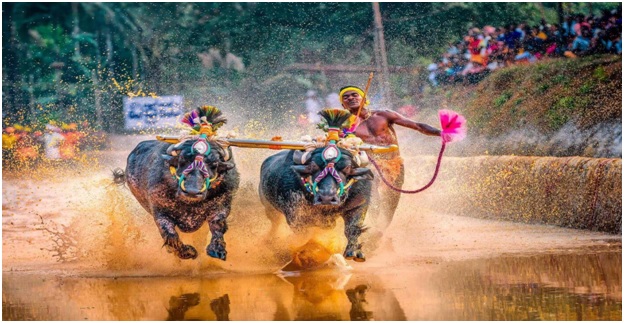
On the weekend of November 25 and 26, 160 pairs of buffaloes and their jockeys will race on specially made slush tracks for Kambala races at City Palace Grounds in Bengaluru.
What is Kambala?
- Kambala is a folk sport rooted in coastal Karnataka, particularly in areas where Tulu speakers are predominant.
- In the past, families and groups used to organize races in the muddy paddy fields after the harvest season.
- For many families, especially those from the Bunt community in coastal regions, Kambala holds significant prestige.
- Throughout the year, they groom pairs of buffaloes with the aim of winning major Kambala events and other races.
Kambala consists of four main categories:
- Negilu (plough): Lighter ploughs are used to tie buffaloes for the race.
- This category is for entry-level buffalo pairs participating in their first Kambala race.
- Hagga (rope): Buffaloes are raced by jockeys with just a rope tied to both buffaloes.
- Adda Halage: Participants stand over a horizontal plank dragged by buffaloes.
- Unlike Hagga and Negilu, where jockeys run behind the animals, buffaloes drag the jockeys in Adda Halage.
- Kane Halage: A wooden plank is tied to buffaloes.
- The plank, on which jockeys stand, has two holes through which water gushes out as it is dragged along the slush tracks.
- The height of water splashes determines the winner of the event.