
Obesity in India: A Public Health Challenge
- 05 Mar 2025
In News:
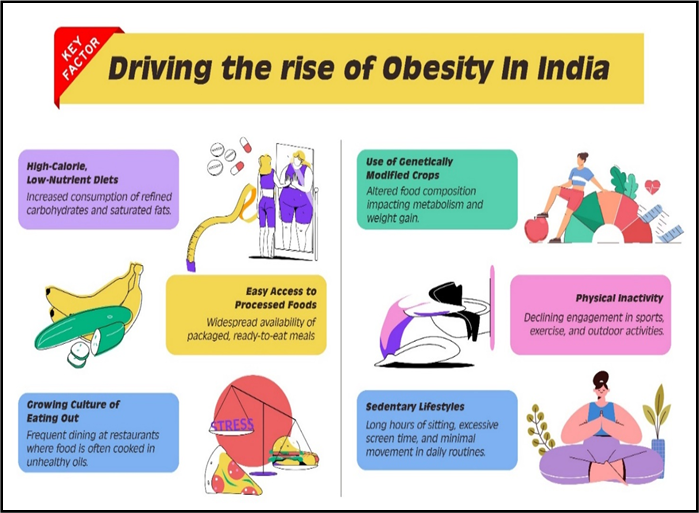
Obesity has emerged as a critical public health issue in India, with rising prevalence across age groups and socio-economic strata. It is a key risk factor for non-communicable diseases (NCDs) like diabetes, cardiovascular diseases, and hypertension. Recognizing its growing burden, the Government of India has adopted a multi-ministerial, community-driven, and policy-integrated strategy to promote healthier lifestyles.
What is Obesity?
- Definition (WHO): Abnormal or excessive fat accumulation that presents a risk to health.
- Measurement: Body Mass Index (BMI = kg/m²)
- Body Mass Index (BMI), previously known as the Quetelet index, is a simple way to check if an adult has a healthy weight. It is calculated by dividing a person's weight in kilograms by their height in meters squared (kg/m²). To find BMI, take a person’s weight (kg) and divide it by their height (m) squared.
- WHO Standard:
- Overweight: BMI ≥ 25
- Obese: BMI ≥ 30
- Indian Criteria (lower threshold):
- Overweight: BMI 23–24.9 kg/m²
- Obese: BMI ≥ 25 kg/m²
- Morbid Obesity: BMI ≥ 35
Prevalence of Obesity
Global Trends (1990–2022):
- Children (5–19 yrs) with obesity: ↑ from 2% to 8%
- Adults with obesity: ↑ from 7% to 16%
India-Specific Data (NFHS-5, 2019–21):
- Overweight/obese: 24% women, 23% men
- Obese (15–49 yrs): 6.4% women, 4.0% men
- Children under 5 (overweight): ↑ from 2.1% (NFHS-4) to 3.4%
Causes of Obesity
- Increased consumption of processed, calorie-dense foods
- Sedentary lifestyle and urbanization
- Reduced physical activity
- Environmental and socio-economic factors
- Excessive use of edible oil, salt, and sugar in Indian diets
Key Government Initiatives to Combat Obesity
1. Ministry of Health and Family Welfare
- NP-NCD (National Programme for Prevention and Control of Non-Communicable Diseases):
- Integrated under Ayushman Bharat Health & Wellness Centres
- Focus: Screening, early diagnosis, IEC/BCC awareness, and NCD clinics
- Facilities: 682 District NCD Clinics, 191 Cardiac Units, 5408 CHC Clinics
2. Ministry of AYUSH
- All India Institute of Ayurveda (AIIA): Specialized treatments (Panchakarma, diet, yoga)
- Ayurswasthya Yojana (2021–22): Funds projects tackling obesity, diabetes, and NCDs
- Research by CCRAS: Validating Ayurvedic lifestyle interventions (Dincharya, Ahara, Yoga)
- Collaboration with CSIR for integrating Ayurveda with modern science
3. Ministry of Women and Child Development
- POSHAN Abhiyaan (2018):
- Focus: Nutrition for children, adolescent girls, pregnant/lactating women
- Mission Saksham Anganwadi &Poshan 2.0 (2021): Combines nutrition, health, wellness
- Use of PoshanVatikas, millet promotion, and fortified food
- Jan Andolan for community-level awareness
4. Ministry of Youth Affairs and Sports
- Fit India Movement (2019):
- Fitness pledges, Fit India School certification, community fitness programs
- Khelo India Programme (2016–17):
- Sports infrastructure and talent development
- Promotes sports culture and active lifestyles in youth
5. Food Safety and Standards Authority of India (FSSAI)
- Eat Right India Movement:
- Supply-Side Reforms:FoSTaC, hygiene ratings, food fortification
- Demand-Side Awareness: Eat Right Schools/Campus, DART Book, Magic Box
- Aaj Se Thoda Kam Campaign: Reduce fat, salt, and sugar intake
- RUCO Initiative: Repurposing Used Cooking Oil into biodiesel
- HFSS Food Labelling: Front-of-pack labels for High Fat, Salt, Sugar foods
Innovative Tools
Tool Description
DART Book Simple home tests for food adulteration
Magic Box 102 school-level food safety experiments
Food Safety on Wheels Mobile food testing & awareness vans
Fit India App Daily fitness tracking and motivation
India’s Way Forward: Towards Amrit Kaal
- Whole-of-government and whole-of-society approach
- Emphasis on lifestyle change, preventive healthcare, and regulation
- Stronger public health infrastructure and education
- Leveraging traditional wellness systems (Ayurveda & Yoga)
- Community empowerment via awareness drives and behavior change
National Policy for Rare Diseases (NPRD) 2021
- 07 Feb 2025
In News:
Patient advocacy groups across India have raised serious concerns over delays in implementing the National Policy for Rare Diseases (NPRD) 2021, which has left many rare disease patients — especially children — in life-threatening situations. They have urged the government for immediate intervention to resume life-saving treatments and release stalled funds under the policy.
Rare Diseases:
- Rare diseases are severe, often genetic, life-threatening disorders that impact a small percentage of the population.
- They disproportionately affect children, with 30% of diagnosed patients not surviving beyond age five without timely treatment.
- Examples include Lysosomal Storage Disorders (LSDs) such as Gaucher, Pompe, Fabry, and MPS I & II.
About NPRD 2021
The Ministry of Health & Family Welfare launched the National Policy for Rare Diseases in March 2021 to streamline the diagnosis, research, and treatment of rare diseases in India.
Key Features of NPRD 2021:
- 63 rare diseases currently included under the policy (as recommended by the Central Technical Committee for Rare Diseases (CTCRD)).
- Categorization of diseases into three groups:
- Group 1: Diseases amenable to one-time curative treatment.
- Group 2: Diseases requiring long-term/lifelong treatment with relatively lower cost.
- Group 3: Diseases requiring very high-cost lifelong therapy where patient selection is critical.
Institutional Support:
- 12 Centres of Excellence (CoEs) identified at premier government hospitals to provide diagnosis and treatment.
- Nidan Kendras established to provide genetic testing and counselling services.
- National Consortium for Research and Development on Therapeutics for Rare Diseases (NCRDTRD) set up to coordinate R&D and promote indigenous drug manufacturing.
- Tax exemptions (on GST and Customs Duty) granted for imported drugs for individual and institutional use.
Financial Provisions:
- Financial assistance of up to ?50 lakh per patient for treatment at CoEs.
- Patients must register at CoEs to receive diagnosis and initiate treatment.
Challenges and Crisis
Despite policy provisions, implementation has been stalled, leading to a healthcare emergency for rare disease patients.
Key Issues Raised:
- Insufficient funding: The ?50 lakh cap is inadequate for chronic and ultra-rare diseases that need lifelong therapy.
- Administrative delays: Fund disbursement to CoEs has been slow, disrupting continuity of treatment.
- Impact on Patients:
- Patients like Alishba Khan, Ashok Kumar, Imran Ghoshi, and Adrija Mudy with Gaucher or MPS I have exhausted their funding.
- Patients who had previously stabilized are now regressing due to interrupted therapy at leading hospitals like AIIMS Delhi, IGICH Bangalore, and IPGMER Kolkata.
Legal Developments:
- On October 4, 2024, the Delhi High Court directed the Ministry of Health and Family Welfare to:
- Release additional funds beyond the ?50 lakh limit.
- Create a ?974 crore National Fund for FY 2024–25 and 2025–26.
- Months later, no concrete action has been taken, further eroding trust in the policy's effectiveness.
Demands by Advocacy Groups
- Sustainable, long-term funding model for lifelong treatment of rare and ultra-rare diseases.
- Immediate fund release to CoEs and simplification of administrative processes.
- Ensure uninterrupted access to essential therapies and expand the scope of financial support.