
Caracal
- 07 May 2026
In News:
The recent confirmation of the rare Caracal (Caracal caracal) in the Thar Desert, situated near the India-Pakistan border, has sparked significant interest within the conservation community. This elusive wild cat, long thought to be on the verge of extinction in the Indian subcontinent, represents a critical link in the arid ecosystem.
Taxonomic and Cultural Context
Despite its common moniker, the "Desert Lynx," the caracal is not a true lynx. Genetic studies reveal it is more closely related to the African golden cat and the serval.
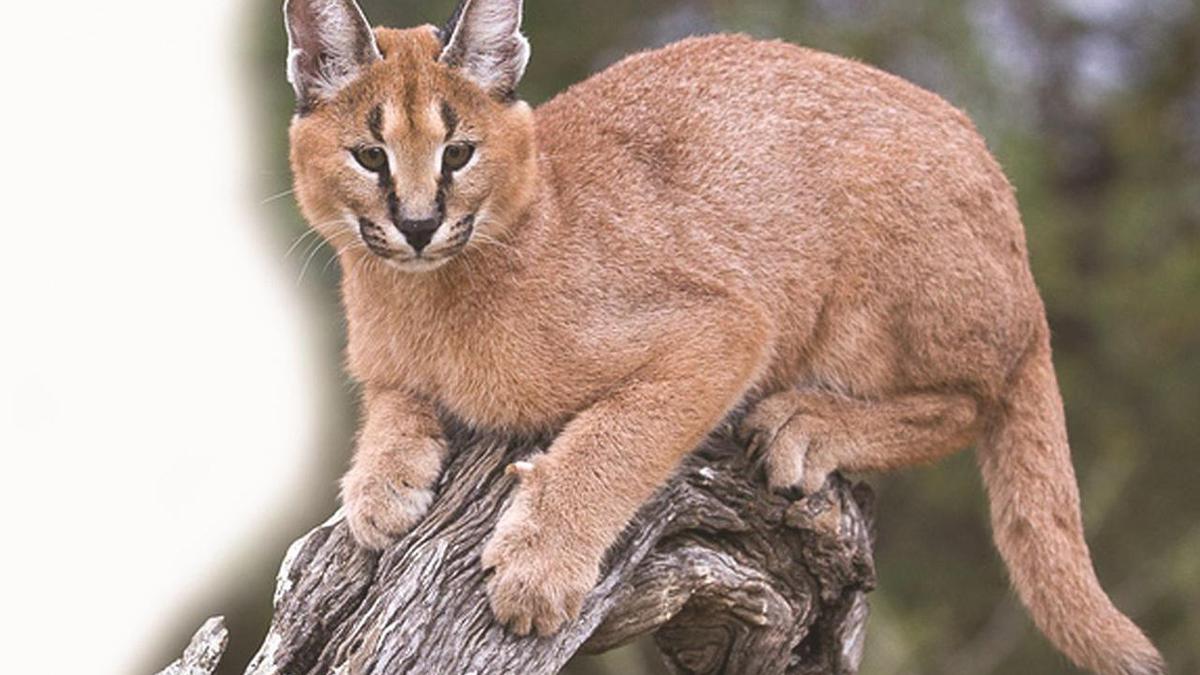
- Etymology: In India, it is historically known as "Siya Gosh," a Persian term meaning "black ear," referring to the distinctive black tufts of fur on its ears.
- Historical Significance: Caracals were traditionally used by royalty in India and Persia for hunting birds, prized for their incredible agility and jumping ability.
Physical Characteristics and Specialized Adaptations
The caracal is an evolutionary marvel, designed for survival in harsh, water-scarce environments.
- Appearance: It possesses a solid, muscular build with disproportionately long legs and a short face. Its fur is typically a uniform reddish-tan or sandy-brown—providing perfect camouflage in desert terrain—though rare melanistic (black) variants have been documented.
- The "Leaping Hunter": The caracal is a remarkable jumper, capable of leaping up to 3 meters (10 feet) vertically into the air to strike down birds with its paws.
- Speed and Stealth: They are highly agile predators, reaching speeds of up to 80 kph (50 mph). Being predominantly nocturnal and shy, they are rarely seen by humans, earning them the reputation of being "ghosts of the desert."
Habitat and Distribution
While the species as a whole has a wide range, the Indian sub-population is critically restricted.
- Global Distribution: Native to Africa, Central Asia, the Middle East, and Northwest India.
- Indian Context: In India, they are found primarily in the arid and semi-arid regions of Rajasthan (Thar Desert and Ranthambore) and Gujarat (Kutch).
- Preferred Environment: They favor dry climates with low rainfall, such as shrublands, savannahs, and semi-deserts. The recent spotting near the international border in the Thar Desert indicates that the species still finds a refuge in the undisturbed, sparsely populated frontier zones.
Ecological Role and Diet
As obligate carnivores, caracals play a vital role as meso-predators in the desert food web. Their diet is diverse, consisting of rodents, small mammals, gazelles, and birds. By controlling the population of smaller herbivores and rodents, they help maintain the balance of the fragile desert vegetation.
Conservation Status and Protection in India
There is a stark contrast between the global and national conservation status of the caracal, which is a critical point for environmental policy discussions.
- IUCN Red List: Least Concern (on a global scale, due to stable populations in Africa).
- Wildlife (Protection) Act, 1972: Schedule I. This provides the caracal with the highest level of legal protection in India, on par with the Tiger and the Asiatic Lion.
- CITES: Listed under Appendix I (for Asian populations), which prohibits international commercial trade.
Major Threats:
The caracal in India faces a "silent extinction" due to several factors:
- Habitat Fragmentation: The conversion of "wastelands" (which are actually vital scrub forests) into agricultural land or industrial zones.
- Loss of Prey Base: Overgrazing by livestock and hunting of small mammals reduces the caracal's food supply.
- Human-Wildlife Conflict: Although rare, caracals sometimes prey on small livestock, leading to retaliatory killings.
Asiatic Caracal
- 20 Nov 2025
In News:
The elusive Asiatic Caracal was recently sighted at Ramgarh in Jaisalmer, marking a significant wildlife record for Rajasthan. Once widespread across India’s grasslands and semi-arid regions, the species had nearly disappeared from public consciousness due to its extremely low numbers and elusive behaviour.
About the Caracal
- Scientific Name:Caracal caracal
- Common Names: Desert lynx (misnomer); Siya gosh in India (Persian for “black ear”)
- Taxonomy: More closely related to the African golden cat and serval than to lynxes
- Type: Medium-sized wild cat, shy and predominantly nocturnal
Distribution
- Global: Africa, Central Asia, the Middle East, arid regions of Pakistan, and north-western India
- India: Extremely rare; estimated population of ~50 individuals, mainly confined to Rajasthan and Gujarat
Habitat
- Occupies semi-deserts, savannahs, shrublands, steppes, dry forests, and woodlands
- Strong preference for dry areas with low rainfall
Key Physical & Behavioural Features
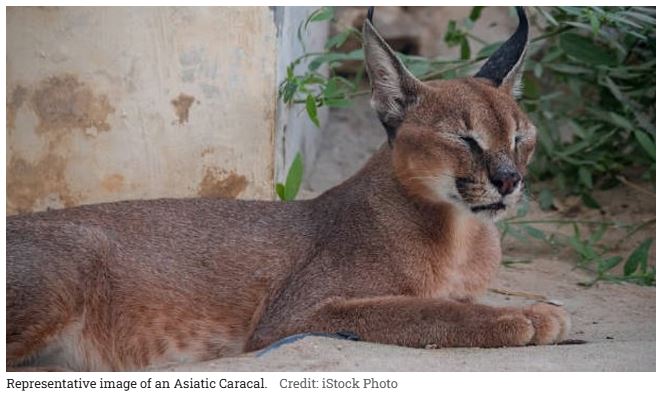
- Solid build, long legs, short face, and distinctive black ear tufts
- Coat colour ranges from red-tan to sandy, with occasional black individuals
- Dark facial markings near eyes and nose; short, dense fur
- Back legs longer than front, aiding agility
- Exceptional leaper: can jump up to 3 metres (10 feet) to catch birds mid-air
- Speed: up to 80 km/h (50 mph) in short bursts
- Largely nocturnal and elusive, making sightings rare
Conservation Status
- IUCN Red List:Least Concern (globally)
- Indian Context: Despite global status, the species is locally threatened due to habitat loss, fragmentation, and very small population size
Caracal
- 10 Oct 2024
In News:
The Gujarat government has recently announced plans to establish a Caracal Breeding and Conservation Center in the Chadva Rakhal area of Kutch, with a budget of ?10 crore.
About the Caracal
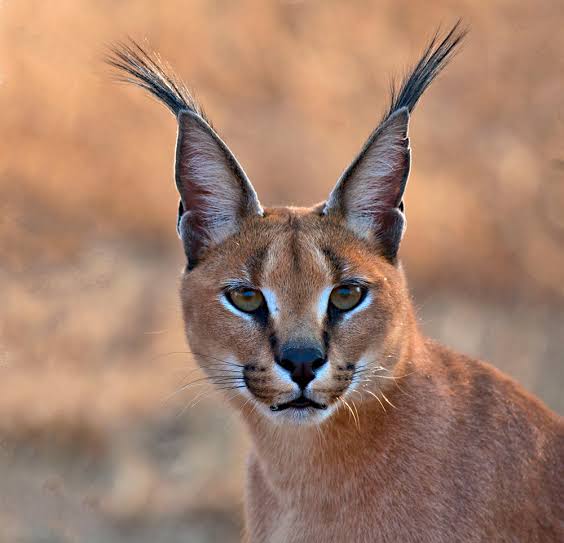
- The caracal, known locally as "siya gosh" (meaning "black ear" in Persian), is a reclusive and primarily nocturnal feline celebrated for its agility and remarkable skill in catching birds mid-flight.
- In terms of nesting, caracals typically utilize abandoned porcupine burrows or rock crevices for denning and are often found with their young hidden among dense vegetation. They tend to live in small groups, and their elusive behavior makes them hard to spot in the wild.
Habitat and Distribution
Caracals inhabit various environments, including woodlands, savannahs, and scrub forests. In India, suitable habitats are found in regions such as Kutch, the Malwa Plateau, the Aravalli hills, and Bundelkhand. This species is also present in numerous countries across Africa, the Middle East, Central Asia, and South Asia.
Threats to Survival
The caracal faces significant threats from extensive hunting, illegal wildlife trade, and the destruction of its natural habitats.
Conservation Status
According to the IUCN, the caracal is classified as "Least Concern." In India, it is protected under Schedule I of the Wildlife (Protection) Act, 1972.