
Ladakh Protest: Demand for Statehood and Inclusion in Sixth Schedule
- 14 Aug 2025
In News:
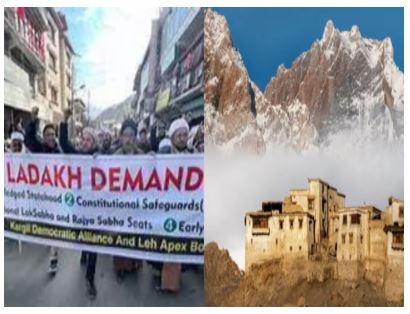
In August 2025, a large protest rally was held in Kargil, led by climate activist Sonam Wangchuk and Ladakh MP Mohmad Haneefa Jan, demanding statehood for Ladakh and its inclusion under the Sixth Schedule of the Constitution. The rally marked the conclusion of a three-day hunger strike and was organized jointly by the Leh Apex Body and the Kargil Democratic Alliance (KDA).
The protesters criticized the delay in resuming dialogue by the Centre, despite the formation of a high-powered committee by the Union Home Ministry in January 2023 to address Ladakh’s concerns. Earlier discussions led to the introduction of a domicile policy with a 15-year eligibility criterion beginning from 2019.
Background
- On 5 August 2019, Article 370 was abrogated, and Jammu & Kashmir was bifurcated into two Union Territories—J&K with legislature and Ladakh without legislature.
- Since then, political groups and civil society in Ladakh have been demanding statehood for democratic representation and Sixth Schedule inclusion to safeguard land, resources, and cultural identity.
Ladakh Statehood Demand
- Objective: To grant a democratically elected legislature with full legislative powers.
- Rationale: Local representation, protection of fragile ecology, and preservation of Ladakh’s unique cultural heritage.
Sixth Schedule of the Constitution
- Constitutional Basis: Articles 244(2) and 275(1).
- Current Applicability: Assam, Meghalaya, Tripura, and Mizoram.
- Purpose: To safeguard tribal communities’ rights through Autonomous District and Regional Councils (ADCs).
Key Features
- Autonomous Councils: Elected bodies with powers over land, forests, agriculture, village administration, and social customs.
- Judicial Powers: Village councils/courts to resolve community disputes.
- Revenue & Taxation: Power to levy taxes on land, trade, and professions.
- Governor’s Role: Can alter council boundaries and approve laws.
- Financial Provisions: Grants-in-aid from the Consolidated Fund of India under Article 275(1).
- Cultural Safeguards: Protection against alienation of tribal land and exploitation by outsiders.
Significance of Demand
- Democratic Governance: Ensures political autonomy and local participation.
- Cultural Protection: Safeguards Ladakh’s Buddhist and tribal identity.
- Environmental Security: Allows better control over fragile Himalayan ecosystems.
- Strategic Importance: Strengthens governance in a border region critical for India’s national security.
Ladakh: Centre agrees to examine demand for statehood, inclusion in Sixth Schedule of Constitution
- 26 Feb 2024
Why is it in the News?
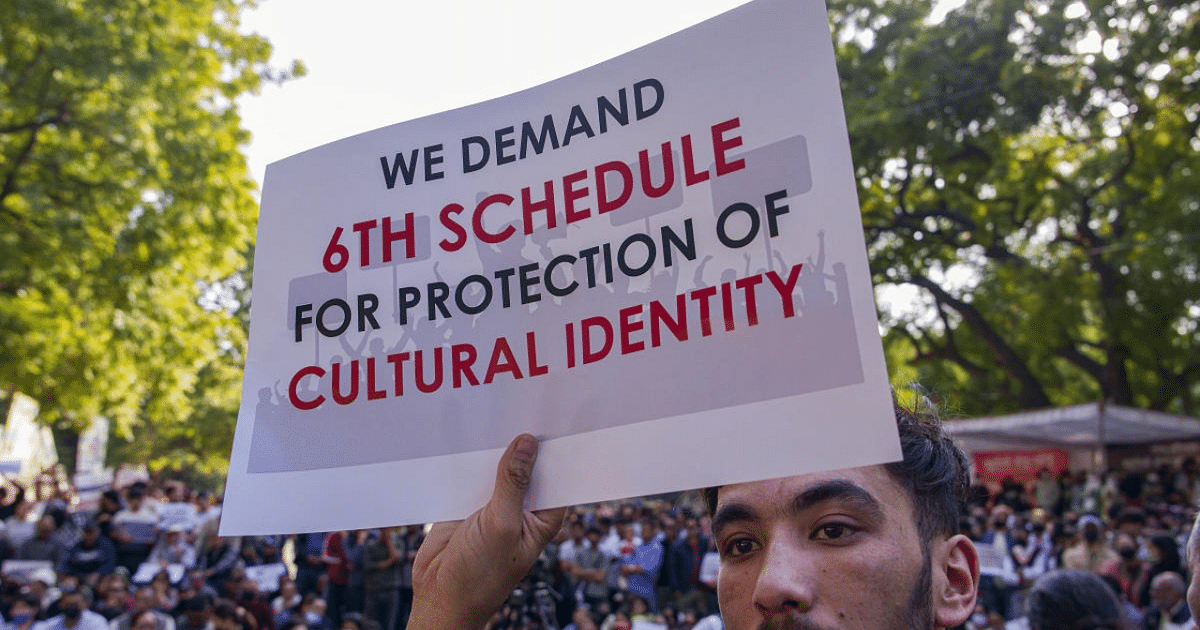
Recently, the Centre has agreed to examine whether the provisions of the Sixth Schedule of the Constitution can be implemented in Ladakh.
What is the Sixth Schedule?
- The Sixth Schedule under Article 244 provides for the formation of autonomous administrative divisions — Autonomous District Councils (ADCs) — that have some legislative, judicial, and administrative autonomy within a state.
- ADCs have up to 30 members with a term of 5 years and can make laws, rules and regulations with regard to land, forest, water, agriculture, village councils, health, sanitation, village- and town-level policing, inheritance, marriage and divorce, social customs and mining, etc.
- The Bodoland Territorial Council in Assam is an exception with more than 40 members and the right to make laws on 39 issues.
- The Sixth Schedule applies to the Northeastern states of Assam, Meghalaya, Mizoram (three Councils each), and Tripura (one Council).
Why does Ladakh want to be part of the Sixth Schedule?
- There was much enthusiasm initially, mostly in Leh, after the August 5, 2019 decisions that created two new Union Territories.
- The Buddhist-dominated Leh district had long demanded UT status because it felt neglected by the erstwhile state government, which was dominated by politicians from Kashmir and Jammu.
- This development has sparked concerns among locals regarding potential challenges related to identity preservation, resource allocation, and administrative oversight.
- Also, the changed domicile policy in Jammu and Kashmir has raised fears in the region about its own land, employment, demography, and cultural identity.
- The UT has two Hill councils in Leh and Kargil, but neither is under the Sixth Schedule.
- Their powers are limited to the collection of some local taxes such as parking fees and allotment and use of land vested by the Centre.
- The Sixth Schedule empowers the Governor of the State to designate specific areas as administrative units within the Autonomous Districts and Autonomous Regions.
Can Ladakh be included in the Sixth Schedule?
- In September 2019, the National Commission for Scheduled Tribes recommended the inclusion of Ladakh under the Sixth Schedule, noting that the new UT was predominantly tribal (more than 97%), people from other parts of the country had been restricted from purchasing or acquiring land there, and its distinct cultural heritage needed preservation.
- Notably, no region outside the Northeast has been included in the Sixth Schedule.
- In fact, even in Manipur, which has predominantly tribal populations in some places, the autonomous councils are not included in the Sixth Schedule.
- Nagaland and Arunachal Pradesh, which are totally tribal, are also not in the Sixth Schedule.
- “Ladakh’s inclusion in the Sixth Schedule would be difficult.
- The Constitution is very clear, the Sixth Schedule is for the Northeast.
- For tribal areas in the rest of the country, there is the Fifth Schedule.
- However, it remains the prerogative of the government — it can, if it so decides, bring a Bill to amend the Constitution for this purpose.