
How La Niña Affects India's Climate?
- 28 Dec 2024
In News:
La Niña, a phase of the El Niño Southern Oscillation (ENSO), occurs when the Pacific Ocean region between Indonesia and South America is cooler than usual. This phenomenon influences global weather patterns, including those in India. Here’s how La Niña specifically affects India’s climate:
Monsoon Rainfall:
- La Niña typically results in normal to above-normal rainfall during the monsoon season in India. This is due to the cooling of sea surface temperatures in the central Pacific, which affects atmospheric circulation and strengthens the monsoon winds.
- In contrast, El Niño usually brings below-average rainfall and droughts to India, leading to agricultural stress.
- Recent La Niña years (2020-2022) saw above-normal monsoon rains, which benefited agricultural productivity, while the El Niño year of 2023 resulted in below-normal rains, impacting water availability and agriculture.
Winter Temperatures:
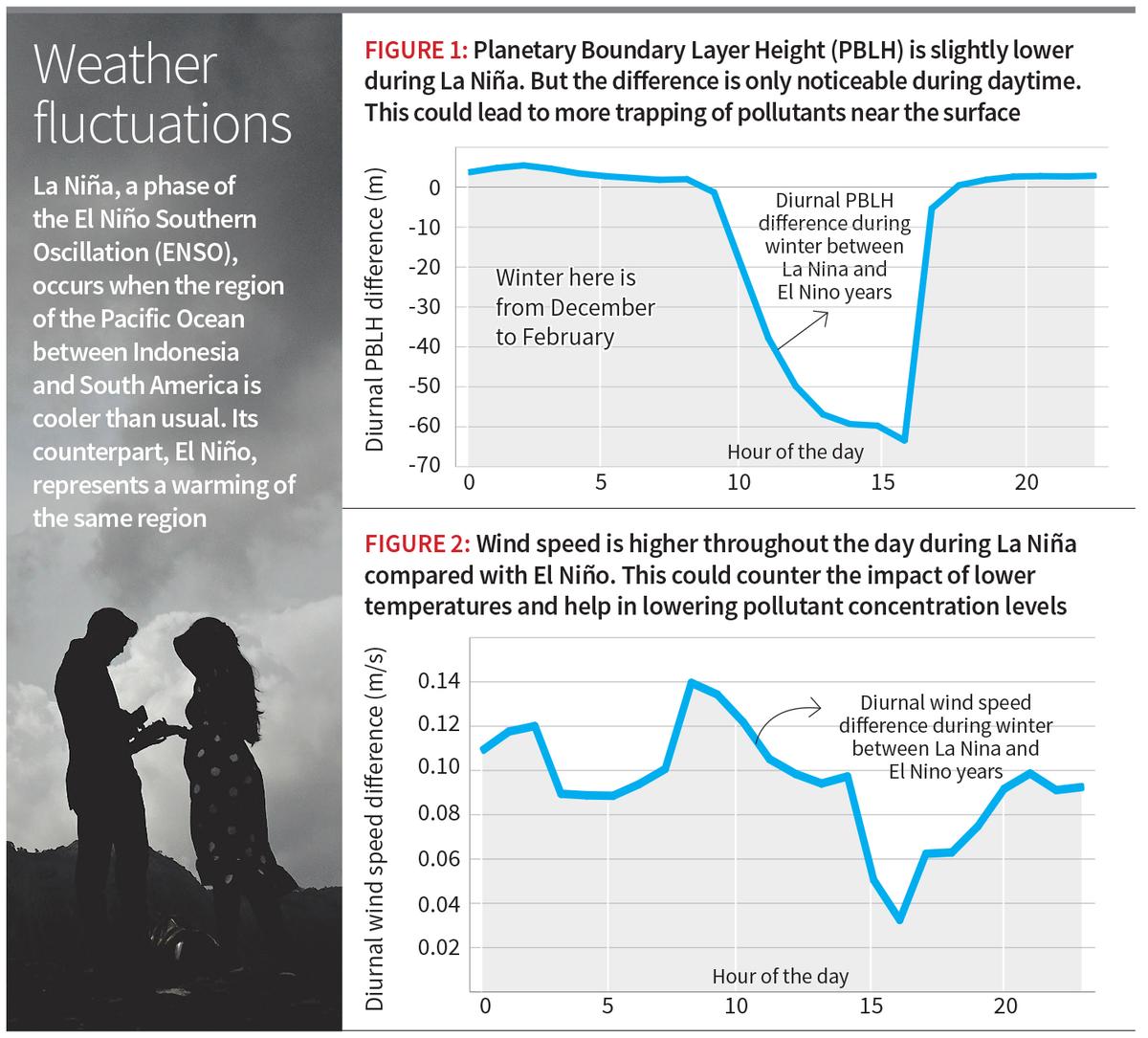
- During La Niña, winter temperatures in India are generally colder in the north, with cooler nights but relatively warmer days compared to El Niño winters. The planetary boundary layer height (PBLH) tends to be lower, trapping pollutants close to the surface. However, higher wind speeds during La Niña help to disperse air pollution, improving air quality.
- South India may experience colder-than-usual winters during La Niña, but current meteorological data suggests the ongoing winter in India is not strongly influenced by La Niña, as its expected onset has been delayed.
Impact on Summer Heat:
- La Niña generally provides relief from extreme summer heat, as it reduces the frequency and intensity of heatwaves. In contrast, El Niño summers are typically hotter and bring record-breaking heat waves.
- For example, April 2023 saw intense heatwaves across India, attributed to the El Niño phase, but if a La Niña forms and persists into the summer of 2025, it could help moderate the extreme heat.
The "Triple Dip" La Niña Phenomenon:
- A Triple Dip La Niña refers to a rare occurrence where three consecutive La Niña events happen, as was the case from 2020 to 2022. This is significant because these prolonged events can lead to stronger climatic impacts. In contrast, the current El Niño (2023) follows this period, potentially contributing to an irregular transition between La Niña and El Niño phases, which may intensify extreme weather patterns.
Global Climate Changes and La Niña:
- Climate change is believed to be increasing the frequency and intensity of both La Niña and El Niño events. Rising sea and land temperatures are disrupting the balance of the Pacific Ocean and could exacerbate extreme La Niña events, which might lead to harsher winters in India and other regions.
Forecast for 2024-2025:
- As of December 2024, the India Meteorological Department (IMD) and global meteorological bodies predict a weak La Niña event to emerge by late 2024 or early 2025. This could lead to colder winters and above-normal rainfall in the 2025 monsoon season, offering some relief from the heatwaves and dry conditions of the previous years.
Conclusion:
If a La Niña forms by the end of 2024, it is likely to bring cooler winters, a relief from extreme summer heat, and above-normal monsoon rainfall in 2025. Given the delayed onset and weakening of the current La Niña, the overall impact on India’s climate in the immediate future might be milder compared to previous La Niña years, but it still holds potential for more favorable conditions for agriculture and air quality.
La Nina and North India’s pollution
- 01 Oct 2024
In News:
Recent research by scientists at the National Institute of Advanced Science (NIAS) has underlined the links between climate change, La Niña and air quality.
Key Points on Air Quality Outlook for Delhi and North India
- Delayed La Niña & Monsoon Retreat:
- Erosion of optimism for improved air quality this winter in Delhi.
- Significant pollution challenges anticipated in early winter months.
- Possible relief in December and January, contingent on La Niña strengthening.
- Impact of Stubble Burning:
- If stubble burning occurs at half the intensity of previous years, November air quality may deteriorate.
- Research Insights:
- Study by National Institute of Advanced Science (NIAS) links climate change, La Niña, and air quality.
- Notable air quality improvement in winter 2022-23 was linked to La Niña conditions.
- Late onset of La Niña contributes to air quality uncertainty.
- Changing Pollution Dynamics:
- Shift from local emission-centric views to broader climatological factors is necessary.
- Air quality in Delhi worsens during winter due to high humidity, calm winds, and poor pollutant dispersion.
- La Niña Delays:
- Delayed La Niña onset means weak winds and stagnant conditions, worsening pollution.
- Expected development between September and November 2024.
- Effects of Stubble Burning:
- North-north-westerly winds could carry pollution from stubble burning in Punjab and Haryana into Delhi.
- Potential Outcomes of Late La Niña Onset:
- If La Niña develops in December or January, may improve air quality slightly.
- However, a longer, severe winter could exacerbate pollution issues due to lower inversion layers.
- NIAS-SAFAR Model Predictions:
- Early La Niña could have worsened air quality in the peninsular region.
- Early onset might have improved northern air quality.
- Link to Climate Change:
- Evidence suggests extreme air pollution correlates with climate change.
- Emphasizes the need for rigorous mitigation efforts and broader airshed management.
- Call for Rethinking Air Quality Strategies:
- Focus on integrating larger climatic factors into air quality policies.
- Prioritize health-centric measures through collaborative efforts with scientific bodies.
What is La Niña?
- La Niña (or ‘The Little Girl’ in Spanish) is a phase of what climatologists refer to as the El Niño Southern Oscillation (ENSO), a phenomenon that is a key driver of global natural climate variability.
- ENSO is characterised by changes in sea temperatures along the tropical Pacific Ocean due to atmospheric fluctuations overhead. These changes alter and interfere with the global atmospheric circulation, and influence weather worldwide.
- Occurring in irregular cycles of anywhere between two to seven years, ENSO has three phases — warm (El Niño or ‘The Little Boy’ in Spanish), cool (La Niña), and neutral.
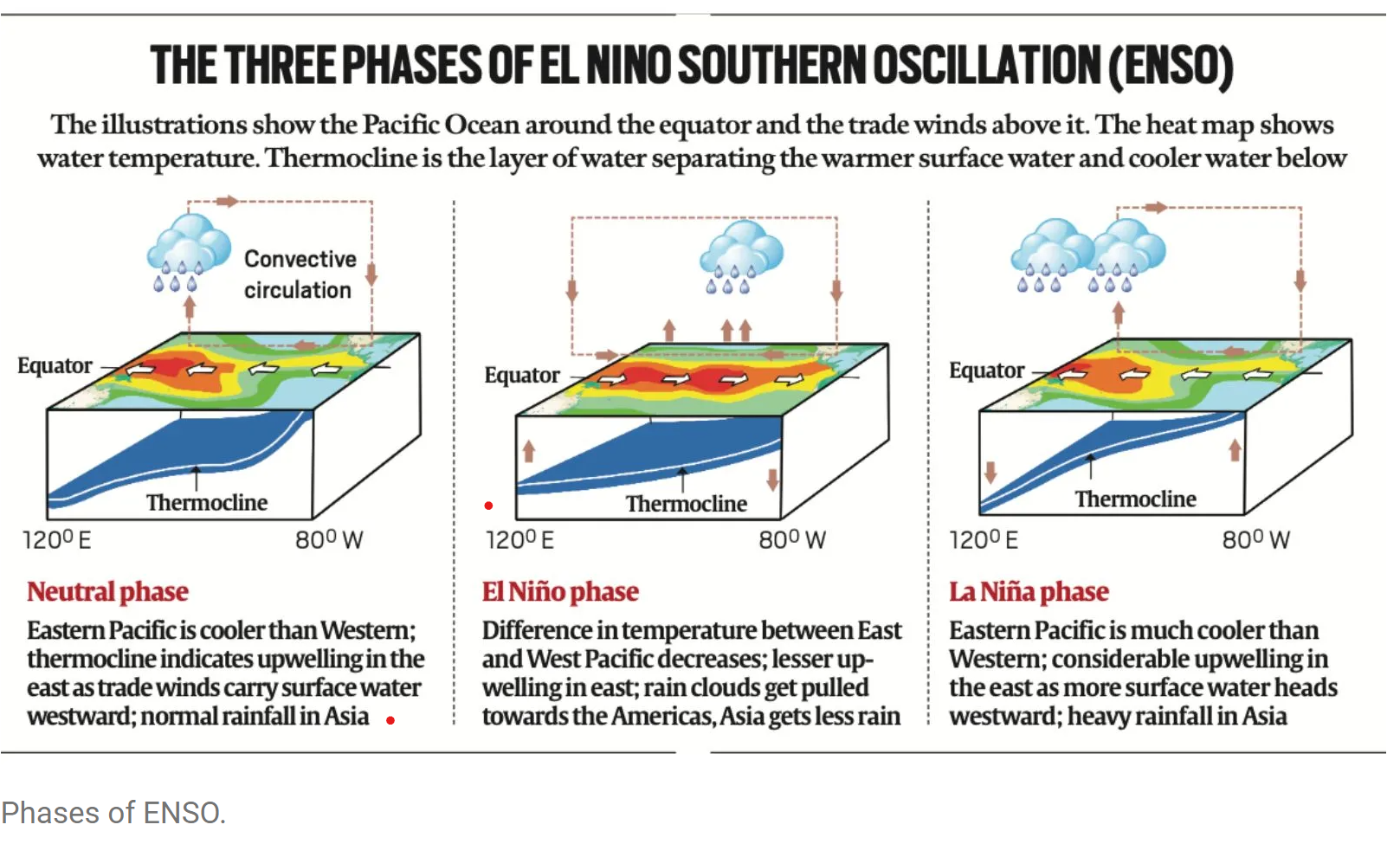
- During the neutral phase, the eastern Pacific (off the northwestern coast of South America) is cooler than the western Pacific (around Philippines and Indonesia). This is because prevailing trade winds — caused by Earth’s rotation, between 30 degrees north and south of the equator — move east to west, sweeping warmer surface water along with them. The relatively cool waters from below rise to the surface to replace the displaced water.
- These wind systems weaken in the El Niño phase, leading to lesser displacement of warmer waters off the American coasts. Consequently, the eastern Pacific becomes warmer than usual. The opposite happens in the La Niña phase i.e. trade winds become stronger than usual and push larger quantities of water to the western Pacific.
El Niño and La Nina
- 23 May 2024
Why is it in the News?
Last month, the India Meteorological Department (IMD) forecasted above-normal rain in the upcoming monsoon season in India, with “favourable” La Nina conditions expected to set in by August-September.
What are El Niño and La Nina?
- El Niño (meaning “little boy” in Spanish) and La Nina (meaning “little girl” in Spanish) are climate phenomena that are a result of ocean-atmosphere interactions, which impact the temperature of waters in the central and eastern tropical Pacific Ocean which affects global weather.
- The Earth’s east-west rotation causes all winds blowing between 30 degrees to the north and south of the equator to slant in their trajectory.
- As a result, winds in the region flow towards a southwesterly direction in the northern hemisphere and a northwesterly direction in the southern hemisphere which is known as the Coriolis Effect.
- Due to this, winds in this belt (called trade winds) blow westwards on either side of the equator.
- Under normal ocean conditions, these trade winds travel westwards along the equator from South America towards Asia.
- Wind movement over the ocean results in a phenomenon called upwelling, where cold water beneath the ocean surface rises and displaces the warm surface waters.
- At times, the weak trade winds get pushed back towards South America and there is no upwelling.
- Thus, warmer-than-usual sea surface temperatures are recorded along the equatorial Pacific Ocean, and this is known as the emergence of El Niño conditions.
- Conversely, during La Nina, strong trade winds push warm water towards Asia.
- Greater upwelling gives rise to cold and nutrient-rich water towards South America.
- Thus, climatologically, El Niño and La Nina are opposite phases of what is collectively called the El Niño Southern Oscillation (ENSO) cycle.
- It also includes a third neutral phase.
- El Niño events are far more frequent than La Nina ones.
- Once every two to seven years, neutral ENSO conditions get interrupted by either El Niño or La Nina.
- Recently, La Nina conditions prevailed between 2020 and 2023.
How could the incoming La Nina impact global weather?
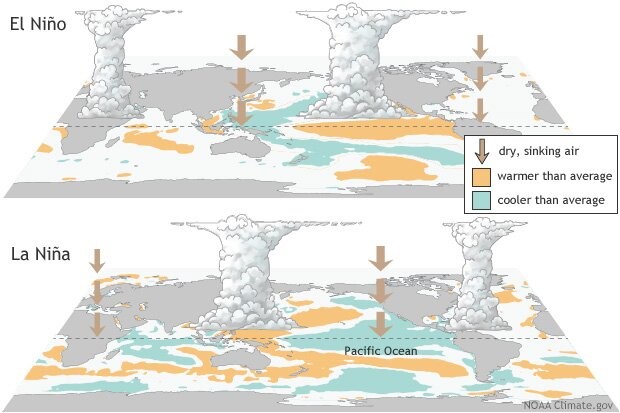
- La Niña, driven by the cooling of ocean waters due to the ENSO (El Niño-Southern Oscillation) cycle, can significantly influence global weather patterns.
- The air circulation loop in the region, affected by these temperature changes, impacts precipitation levels in neighbouring areas and can alter the Indian monsoon.
- Currently, the El Niño event that began in June last year has significantly weakened.
- Neutral ENSO conditions are expected to be established by June.
- Following this, La Niña conditions are anticipated to emerge, with its effects likely becoming apparent from August.
La Nina’s Impact on India:
- With above normal rain forecast, the seasonal rainfall is expected to be 106 per cent of the Long Period Average (LPA), which is 880mm (1971-2020 average).
- Except in east and northeast India, all remaining regions are expected to receive normal or above-seasonal rainfall.
- Heavy rains could result in some regions witnessing riverine and urban flooding, mudslides, landslides and cloudbursts.
- East and northeast India region, during La Nina years, receive below average seasonal rainfall.
- Therefore, there may be a shortfall in water reserves there this year.
- During La Nina years, incidents of thunderstorms generally increase.
- “The east and northern India regions could experience thunderstorms accompanied by lightning.
- With increased farming activities undertaken during the July and August rainy months, which coincides with the season’s enhanced lightning and thunderstorms, there is a high risk of fatalities in these regions.
- In addition to ENSO, there are other parameters that can impact the monsoon.
- However, in a La Nina year, a deficit monsoon over India can be easily ruled out.
La Nina’s Impact on the World:
- Similar to India, Indonesia, the Philippines, Malaysia and their neighbouring countries receive good rainfall during a La Nina year.
- This year, Indonesia has already witnessed floods.
- On the other hand, droughts are common in southern regions of North America, where winters become warmer than usual.
- Canada and the northwestern coast of the United States see heavy rainfall and flooding.
- Southern Africa receives higher than usual rainfall, whereas eastern regions of the continent suffer below-average rainfall.
- ENSO has a huge impact on hurricane activity over the Atlantic Ocean.
- During a La Nina year, the hurricane activity here increases.
- For instance, the Atlantic Ocean churned out a record 30 hurricanes during the La Nina year 2021.
Is Climate Change Affecting ENSO?
- Over India, El Niño is known to suppress the southwest monsoon rainfall and drive higher temperatures and intense heat waves, like the present summer season.
- In the past, monsoon seasons during years following an El Niño were 1982-1983 and 1987-1988, with both 1983 and 1988 recording bountiful rainfall.
- At present too, a similar situation could play out.
- The 2020-2023 period witnessed the longest La Nina event of the century.
- Thereafter, ENSO neutral conditions developed, which soon gave way to El Niño by June 2023 which has been weakening since December last year.
- Scientists say that climate change is set to impact the ENSO cycle.
- Many studies suggest that global warming tends to change the mean oceanic conditions over the Pacific Ocean and trigger more El Niño events.
- The World Meteorological Organization (WMO) has also said that climate change is likely to affect the intensity and frequency of extreme weather and climate events linked to El Niño and La Nina.
La Nina impacted air quality in India in the winter of 2022
- 20 Feb 2024
Why is it in the News?
A new study suggests that monsoon rainfall over India, which is strongly influenced by El Niño and La Niña events—alternating warming and cooling of the eastern Pacific Ocean impacting global weather may also affect air quality in the country.
Key Findings of the New Study on the Impact of La Niña on Air Quality in India:
- According to the researchers at the National Institute of Advanced Studies (Bengaluru) and the Indian Institute of Tropical Meteorology (Pune), the strong influence of El Niño and La Niña events on monsoon rainfall over India, driven by the alternating warming and cooling of the eastern Pacific Ocean, with far-reaching effects on global weather patterns.
- Remarkably, this study marks the first time that air quality in Indian cities has been directly linked to a La Niña event, suggesting an indirect connection to climate change, which intensifies the severity of El Niño and La Niña occurrences.
- Traditionally, northern Indian cities, notably Delhi, face elevated concentrations of PM2.5 pollutants from October to January.
- However, the winter of 2022 witnessed a notable deviation from this trend, with northern cities experiencing cleaner air than usual, while western and southern cities like Mumbai, Bengaluru, and Chennai saw worsened air quality.
- Specifically, Delhi observed a 10% reduction in PM2.5 concentrations, contrasted with a 30% increase in Mumbai and a 20% rise in Bengaluru.
- The researchers, investigating this anomaly, identified the potent effects of the La Niña event, notably stronger than typical occurrences, leading to significant changes in wind circulation patterns over India.
- This impact became pronounced in the third year of La Niña, suggesting a cumulative effect that may amplify over time.
- While La Niña events are associated with improved air quality in northern India, the study emphasizes the need for further research to understand the potential impacts of El Niño events, which may produce contrasting effects on air quality across the country.
What are El Niño and La Niña?
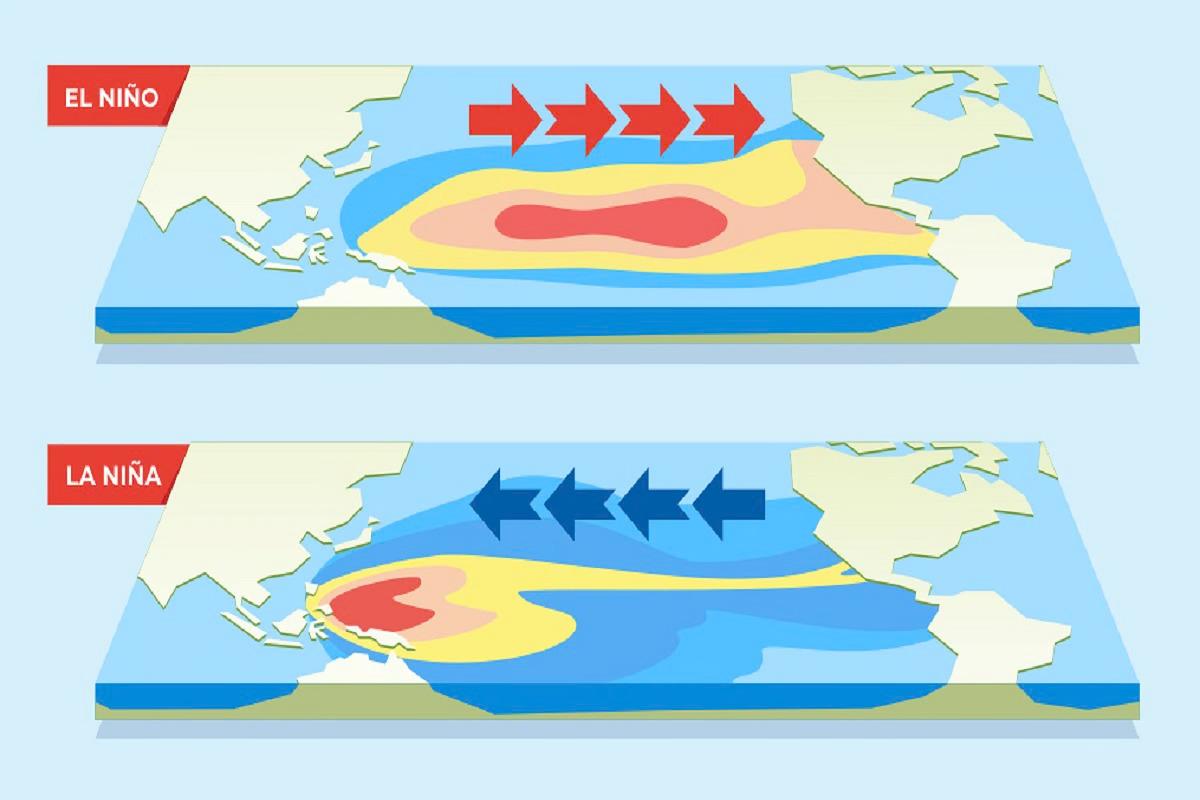
- El Niño refers to a band of warmer water spreading from west to east in the equatorial Pacific Ocean.
- Similarly, a La Niña occurs when the band of water spreads east to west and is cooler.
- Both phenomena affect the weather worldwide and can have drastic effects on economies that depend on rainfall.
- Together, El Niño and La Niña make up a cyclical process called the El Niño Southern Oscillation.
- An El Niño year creates a global warming crisis in miniature because the warm water spreading across the tropical Pacific releases a large amount of heat into the atmosphere.
- El Niño: El Niño is characterized by warmer-than-average sea surface temperatures in the central and eastern Pacific Ocean.
- In India, El Niño events often correlate with below-average rainfall during the monsoon season.
- This can lead to drought conditions in some regions, affecting agriculture and water resources.
- El Niño can also influence temperature patterns, with some parts of India experiencing warmer temperatures during El Niño events.
- La Niña: La Niña is characterized by cooler-than-average sea surface temperatures in the central and eastern Pacific Ocean.
- In India, La Niña events often correlate with above-average rainfall during the monsoon season.
- This can lead to increased precipitation in some regions, potentially causing flooding, while other areas may experience drought conditions.
- La Niña can also influence temperature patterns, with some parts of India experiencing cooler temperatures during La Niña events.
Impact of La Niña on Air Quality in India:
- Altering Wind Patterns: During the winter of 2022, the typical north-westerly winds, carrying agricultural pollutants from Punjab and Haryana towards Delhi and the Gangetic plains, were disrupted.
- Instead, wind circulation shifted to a north-south direction, diverting pollutants away from Delhi.
- Consequently, pollutants bypassed Delhi, travelling over Rajasthan and Gujarat towards southern regions.
- Modifying Local Wind Circulation near Mumbai: In Mumbai, the local wind circulation, which alternates between land-to-sea and sea-to-land flows every few days, experienced prolonged unidirectional winds.
- This sustained wind pattern prevented the dispersal of pollutants from the city, leading to their accumulation within Mumbai's atmosphere throughout the winter of 2022.
- These changes in wind patterns, influenced by La Niña, significantly impacted air quality dynamics in India, highlighting the intricate relationship between climate phenomena and regional atmospheric conditions.