
India’s Startup Revolution
- 20 Apr 2026
In News:
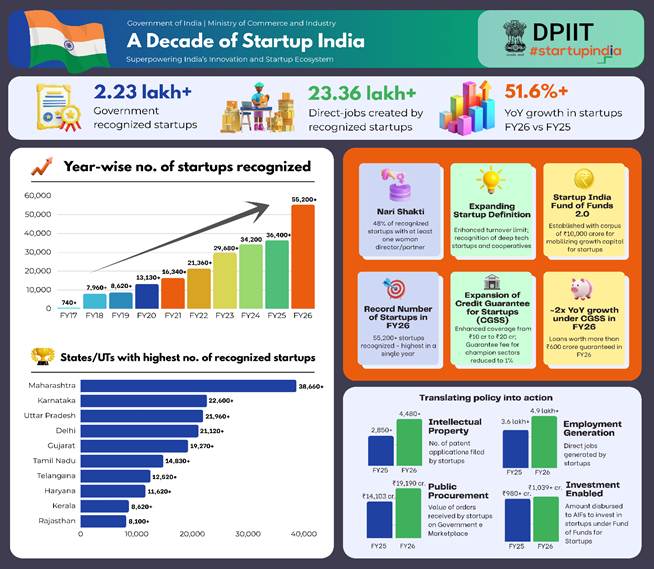
The Financial Year 2025–26 has emerged as a watershed moment for India’s entrepreneurial landscape. According to the latest data from the Department for Promotion of Industry and Internal Trade (DPIIT), the Startup India initiative witnessed its strongest performance since its inception in 2016. With over 55,200 startups recognized in a single year—a 51.6% year-on-year increase—India is rapidly cementing its position as a global innovation hub, transitioning from a job-seeking to a job-creating economy.
Key Performance Indicators (FY 2025–26)
The scale of growth in the startup ecosystem is reflected in several record-breaking metrics:
- Total Ecosystem Strength: The total number of recognized startups has crossed 2.23 lakh.
- Employment Generation: Startups have generated over 23.36 lakh direct jobs to date. In FY 2025-26 alone, direct job creation rose by 36.1%, adding nearly 5 lakh jobs in a single year.
- Women Empowerment: Demonstrating inclusive growth, approximately 48% of total recognized startups (over 1.07 lakh) have at least one-woman director or partner.
- Intellectual Property: Innovation is peaking, with patent filings by startups jumping from 2,850 in the previous year to over 4,480 in FY 2025–26.
Geographical Spread and Competitive Federalism
The startup movement is no longer confined to traditional tech hubs but has reached every State and Union Territory. However, five regions lead the charge in concentration and employment:
- Maharashtra: 38,660 startups; 4.13 lakh jobs.
- Karnataka: 22,600 startups; 2.46 lakh jobs.
- Uttar Pradesh: 21,960 startups; 2.11 lakh jobs.
- Delhi: 21,120 startups; 2.36 lakh jobs.
- Gujarat: 19,270 startups; 2.14 lakh jobs.
To sustain this momentum, the States’ Startup Ranking Framework (SRF) promotes competitive federalism, evaluating states on policy implementation and classifying them into categories like "Best Performers" and "Top Performers."
The Support Pillars: Flagship Schemes
The government provides a multi-layered financial and regulatory support system to nurture startups throughout their lifecycle:
- Fund of Funds for Startups (FFS): To address the funding gap, FFS 1.0 has disbursed over ?7,000 crore to Alternative Investment Funds (AIFs), which in turn invested over ?26,900 crore in startups. Building on this, FFS 2.0 has been notified with a fresh corpus of ?10,000 crore.
- Startup India Seed Fund Scheme (SISFS): Focuses on early-stage needs like proof of concept and prototyping. The entire ?945 crore corpus has been committed, supporting over 3,400 startups through 219 incubators.
- Credit Guarantee Scheme (CGSS): Facilitates collateral-free loans. In FY 2025–26, the guarantee cover was doubled from ?10 crore to ?20 crore per borrower to enhance capital mobilization.
- Government e-Marketplace (GeM): Startups are increasingly participating in public procurement. Over 38,600 startups are onboarded on GeM, with the total value of orders placed reaching ?19,190 crore in the current fiscal year.
Institutional Mechanisms for Mentorship
Beyond capital, the ecosystem emphasizes "ease of doing business" through digital integration:
- MAARG Portal: (Mentorship, Advisory, Assistance, Resilience, and Growth) serves as a single-stop platform for mentorship across sectors.
- Startup India Hub: A single-window digital platform connecting founders with investors, incubators, and government bodies.
- Startup India Investor Connect: Specifically bridges the gap between high-potential founders and the global investor community.