
Delimitation and Women’s Reservation in Legislatures
- 19 Apr 2026
In News:
The Union government has introduced a historic legislative package aimed at reshaping India's parliamentary landscape. Through the Constitution (131st Amendment) Bill, 2026, the Delimitation Bill, 2026, and the Union Territories Laws (Amendment) Bill, 2026, the government seeks to synchronize three critical democratic objectives: the expansion of the Lok Sabha, the conduct of a fresh delimitation exercise based on recent data, and the immediate operationalization of the Nari Shakti Vandan Adhiniyam (33% women’s reservation).
Key Legislative Provisions
1. The Constitution (131st Amendment) Bill, 2026
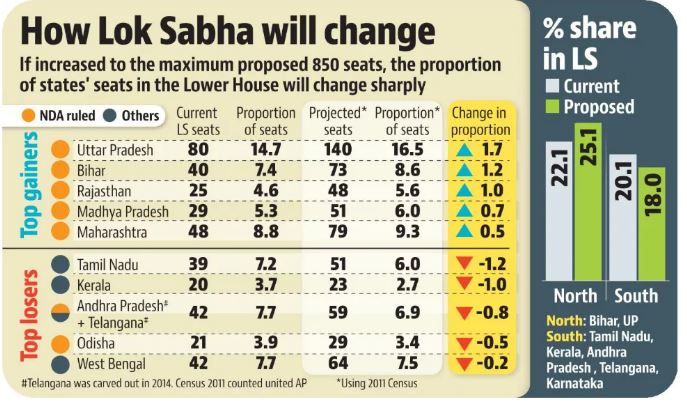
- Expansion of Lok Sabha: The Bill proposes amending Article 81 to increase the maximum strength of the Lok Sabha from 550 to 850 members. This includes 815 representatives from States and 35 from Union Territories.
- Decoupling from the Post-2026 Census: Current provisions under Article 81 and 82 freeze seat allocation based on the 1971 Census until the first census after 2026 is published. The new amendment removes this "delimitation freeze," allowing the government to use the 2011 Census (or any census Parliament decides by law) to redraw boundaries immediately.
- Legislative Hurdles: As a constitutional amendment affecting federal representation, this Bill requires a special majority in both Houses of Parliament and ratification by at least 50% of State Legislatures.
2. The Delimitation Bill, 2026
- The Commission: This Bill replaces the Delimitation Act of 2002 and establishes a new Delimitation Commission. The body will be chaired by a Supreme Court judge and include the Chief Election Commissioner and State Election Commissioners.
- Mandate: The Commission is tasked with redrawing territorial constituencies to ensure they are geographically compact and reflect population shifts, upholding the principle of “one person, one vote, one value.”
- Finality of Orders: Once the Commission’s orders are notified, they carry the force of law and cannot be challenged in any court.
3. The Union Territories Laws (Amendment) Bill, 2026
- This enabling legislation extends the structural changes and women’s reservation to UTs with legislatures, specifically Delhi, Puducherry, and Jammu & Kashmir.
Operationalizing Women’s Reservation
The impending delimitation acts as the "trigger" for the 106th Constitutional Amendment Act, 2023.
- Implementation Timeline: By fast-tracking delimitation, the government aims to implement the 33% quota for women in the 2029 General Elections.
- Quota Dynamics: The reservation includes a sub-quota for SC/ST women but currently lacks a separate provision for OBC women. These seats will be rotated after every delimitation cycle and are subject to a 15-year "sunset clause," unless extended by Parliament.
The Core Conflict: Representation vs. Federalism
While the government emphasizes democratic parity, the move has ignited a debate over India’s federal equilibrium:
Arguments in Favor (Democratic Equity):
- Parity of Representation: Currently, an MP from a high-population state like Uttar Pradesh represents significantly more voters than an MP from a southern state, diluting the democratic weight of citizens in the north.
- Ease of Transition: Expanding the House to 850 seats ensures that while northern states gain more, no state will see a reduction in its absolute number of seats. All states are projected to see a nearly 50% increase in their total seat count.
Arguments Against (Regional Imbalance):
- The "Penalty" for Success: Southern states (Kerala, Tamil Nadu, etc.) argue that they are being punished for their success in population control and socio-economic development. Their relative political weight in the Lok Sabha is set to shrink.
- Financial Disparity: Critics argue that southern states contribute a higher share to the national GDP and tax pool. Reduced political say leads to a "taxation without representation" sentiment.
- Presidential Election Impact: Changing the number of MPs and MLAs will alter the Electoral College, potentially giving northern states a disproportionate influence in electing the President of India.
The Judicial Perspective
Historically, delimitation orders have been immune from judicial interference to prevent election delays. However, in the Kishorchandra Chhanganlal Rathod Case (2024), the Supreme Court clarified that such orders can be reviewed if they are found to be "manifestly arbitrary" or violate core constitutional values.