
Biomass-based Improved Cookstoves (ICS)
- 19 Apr 2026
In News:
In the wake of recent LPG supply disruptions and rising fuel costs, the conversation around India's energy transition has pivoted toward Modern Biomass-based Improved Cookstoves (ICS). While the Pradhan Mantri Ujjwala Yojana (PMUY) significantly expanded LPG access, many rural households have begun "stacking" fuels or shifting back to traditional firewood due to affordability issues. In this context, ICS emerges not as a step backward, but as a sophisticated, cost-effective bridge to cleaner energy.
The Technology: Redefining Biomass Combustion
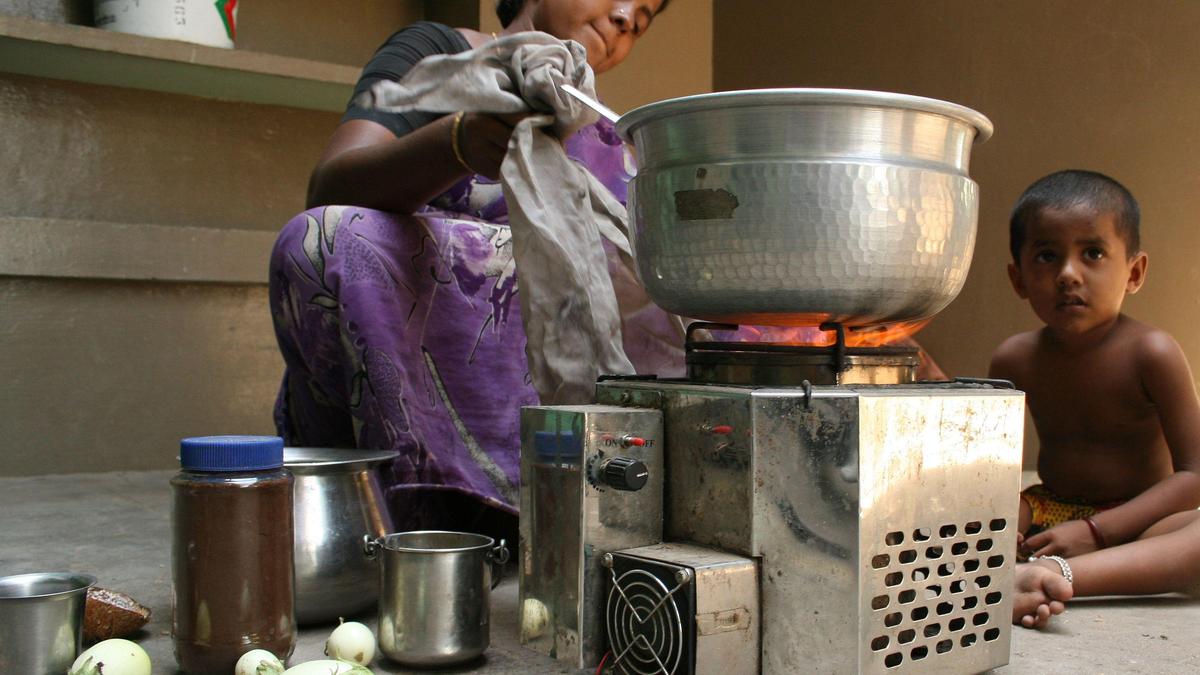
Improved Cookstoves are advanced thermal devices engineered to maximize combustion efficiency while minimizing the release of harmful pollutants. Unlike the traditional mud chulha, which is plagued by poor airflow and massive heat loss, ICS integrates modern thermodynamic principles.
- Efficiency Gains: Traditional stoves operate at a dismal efficiency of roughly 10%. In contrast, ICS achieves an efficiency of 38–45%.
- Secondary Aeration: A key technological feature in ICS is the introduction of secondary air. This process captures soot and volatile gases—which would otherwise escape as smoke—and re-combusts them. This "double burn" significantly improves indoor air quality.
The Economic and Environmental Value Proposition
For a rural household, the transition to ICS offers a compelling alternative to both traditional wood-firing and expensive LPG:
- Cost Efficiency: With firewood priced at approximately ?10/kg compared to LPG costs often exceeding ?100/kg, ICS can offer savings of over 60% for economically vulnerable families.
- Resource Conservation: Due to superior thermal efficiency, ICS can reduce the volume of firewood required by 50–66%, directly reducing the drudgery of fuel collection for women and lessening the pressure on local forests.
- Fuel Versatility: ICS models are increasingly designed to be "fuel-agnostic," capable of burning processed biomass such as pellets and briquettes, as well as raw materials like crop residues and dung cakes.
A Sustainable Financing Model: Carbon Credits
One of the most innovative aspects of modern ICS deployment is its link to the global carbon market. Because these stoves demonstrably reduce CO2 and black carbon emissions, they generate carbon credits. These credits can be traded to:
- Subsidize Upfront Costs: Making the stoves affordable for low-income households.
- Fund CSR Initiatives: Encouraging corporate involvement in rural energy health.
- Support Microfinance: Creating a circular economy where emission reductions pay for the hardware.
Implementation Challenges and the Way Forward
Despite their benefits, the large-scale adoption of ICS faces significant hurdles:
- The "Last-Mile" Logistical Gap: Unlike LPG, which relies on a centralized bottling infrastructure, ICS success depends on decentralized, local distribution networks and robust after-sales support to ensure stoves remain functional.
- Emission Trade-offs: While ICS is significantly cleaner than a traditional chulha, its emissions are generally higher than those of LPG or electric cooking. It is a "transitional" technology rather than an ultimate "zero-emission" solution.
- Awareness and Behavioral Change: Deep-seated cultural cooking habits often act as a barrier to adopting new stove designs, requiring sustained community engagement.