
India’s Chairmanship of the Kimberley Process
- 11 Mar 2026
In News:
India’s assumption of the chairmanship of the Kimberley Process Certification Scheme (KPCS) provides an important opportunity to strengthen global mechanisms aimed at preventing the trade in conflict diamonds. As one of the largest players in the global diamond value chain, India’s leadership in the Kimberley Process can enhance transparency, improve traceability, and reinforce responsible diamond trade.
Conflict Diamonds: Meaning and Background
- Conflict diamonds, also known as blood diamonds, refer to rough diamonds mined in war zones and sold by rebel groups or their allies to finance armed conflicts against legitimate governments.
- The term gained global attention in the 1990s, when diamonds were found to be funding violent conflicts in several African countries such as Angola, Sierra Leone, Rwanda, and Liberia.
- These diamonds often entered global markets through informal and illegal trade networks, making their origin difficult to trace and raising concerns about ethical sourcing in the international diamond trade.
Kimberley Process Certification Scheme (KPCS)
The Kimberley Process, established in 2003, is a multilateral and voluntary certification mechanism designed to prevent conflict diamonds from entering the legitimate global diamond market.
Key features include:
- Certification System – Every shipment of rough diamonds traded between participating countries must carry a Kimberley Process Certificate, confirming that the diamonds are conflict-free.
- Trade Restrictions – Participating countries are allowed to trade rough diamonds only with other members of the Kimberley Process.
- Global Coverage – The Kimberley Process accounts for over 99% of global rough diamond trade, making it a crucial framework for responsible diamond governance.
- Monitoring and Compliance – Members commit to implementing internal controls and reporting mechanisms to ensure transparency in diamond trade.
India’s Diamond Industry
India plays a central role in the global diamond value chain:
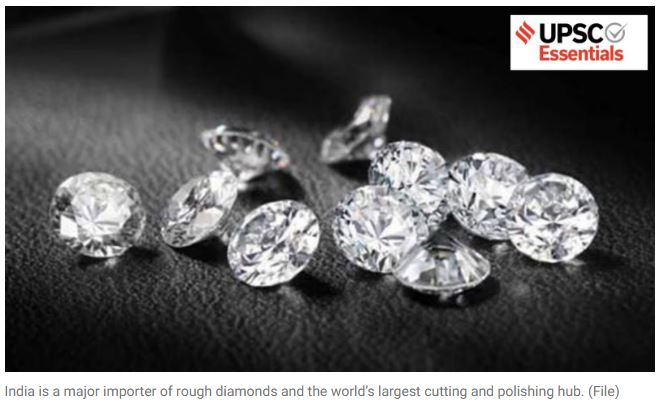
- Largest cutting and polishing hub in the world, especially in cities such as Surat.
- Major importer of rough diamonds for processing.
- Leading exporter of cut and polished diamonds, with exports valued at about $13.3 billion in 2024–25.
- Second-largest diamond consumer market after the United States.
The Gem and Jewellery Export Promotion Council (GJEPC) acts as the nodal agency for implementing Kimberley Process certification in India. It operates under the Department of Commerce, Ministry of Commerce and Industry and is responsible for issuing certificates for diamond exports and imports.